487. “Fear Not!”  Why Believers Have No Need To Fear

The phrase, “Fear not!” is found 33 times in the ESV Bible. When fear is so prevalent in today’s world it would help us to understand why God in His word tells us not to be afraid. Let’s see in the Bible the reasons why believers do not need to be afraid as they live for God in His world. 

1]. “Fear Not, For I Am With You!” The Lord Promises To Be With His People At All Times

Gen 26:24  And the LORD appeared to him the same night and said, “I am the God of Abraham your father. Fear not, for I am with you and will bless you and multiply your offspring for my servant Abraham’s sake.”

Isa 41:10  fear not, for I am with you; be not dismayed, for I am your God; I will strengthen you, I will help you, I will uphold you with my righteous right hand.

Isa 41:13  For I, the LORD your God, hold your right hand; it is I who say to you, “Fear not, I am the one who helps you.”

Isa 43:5  Fear not, for I am with you; I will bring your offspring from the east, and from the west I will gather you.

Jer 46:28  Fear not, O Jacob my servant, declares the LORD, for I am with you. I will make a full end of all the nations to which I have driven you, but of you I will not make a full end. I will discipline you in just measure, and I will by no means leave you unpunished.”

Hag 2:5  according to the covenant that I made with you when you came out of Egypt. My Spirit remains in your midst. Fear not.

In all these verses we note that the Lord wants to be with His people in all situations. While they continue to trust Him, they have no need to fear. However that does not mean that they are exempt from His chastisement. As God spoke through the writer of the epistle to the Hebrews, “Besides this, we have had earthly fathers who disciplined us and we respected them. Shall we not much more be subject to the Father of spirits and live? 10  For they disciplined us for a short time as it seemed best to them, but he disciplines us for our good, that we may share his holiness. 11  For the moment all discipline seems painful rather than pleasant, but later it yields the peaceful fruit of righteousness to those who have been trained by it.” Hebrews 12:9-11. 

Even when God has to chastise His people, [and He will for none of us live perfect lives] it is for their good, that they might share the holiness of God. The end result is that they might enjoy “the peaceful fruit of righteousness.” God chastises His people in His love, not in anger. He wants the very best for His people.

2]. “Fear Not!” The Lord Promises To Redeem, Save And Protect His People

Gen 15:1  After these things the word of the LORD came to Abram in a vision: “Fear not, Abram, I am your shield; your reward shall be very great.”

Isa 41:14  Fear not, you worm Jacob, you men of Israel! I am the one who helps you, declares the LORD; your Redeemer is the Holy One of Israel.

Isa 43:1  But now thus says the LORD, he who created you, O Jacob, he who formed you, O Israel: “Fear not, for I have redeemed you; I have called you by name, you are mine.

Jer 30:10  “Then fear not, O Jacob my servant, declares the LORD, nor be dismayed, O Israel; for behold, I will save you from far away, and your offspring from the land of their captivity. Jacob shall return and have quiet and ease, and none shall make him afraid.

Jer 46:27  “But fear not, O Jacob my servant, nor be dismayed, O Israel, for behold, I will save you from far away, and your offspring from the land of their captivity. Jacob shall return and have quiet and ease, and none shall make him afraid.

The Lord is not only the Creator of His people, He is also the One who redeems them and protects them as they live for Him.  We see the privilege of belonging to the Lord as His people in the words in Isaiah 43:1  “Fear not, for I have redeemed you; I have called you by name, you are mine.” We know we have a great responsibility to live lives that bring glory to Christ, but we often overlook the privilege we have in being called by His name as Christians, those who belong to Christ. We belong to Him not because we chose Him to be our Saviour and Lord but because Christ took the initiative and chose us to be His, “You did not choose me, but I chose you and appointed you that you should go and bear fruit and that your fruit should abide, so that whatever you ask the Father in my name, he may give it to you.” John 15:16

In 1Peter 2:9 we see both our privilege and our responsibility as Christ’s chosen ones being entwined in the same verse, “But you are a chosen race, a royal priesthood, a holy nation, a people for his own possession, that you may proclaim the excellencies of him who called you out of darkness into his marvellous light.” We have the privilege of belonging to Him by His initiative and grace, and our responsibility is to live for Him by proclaiming His excellencies. “Called” reminds us of our being called out of the world to belong to Him.  Indeed that is the meaning of the word “church” which in the Greek is “ekklesia” or the “called out ones.”[From ek meaning out of and klesia a calling.]

3]. “Fear Not!” The Lord Promises To Hear The Cries Of His People

Gen 21:17  And God heard the voice of the boy, and the angel of God called to Hagar from heaven and said to her, “What troubles you, Hagar? Fear not, for God has heard the voice of the boy where he is.

Dan 10:12  Then he said to me, “Fear not, Daniel, for from the first day that you set your heart to understand and humbled yourself before your God, your words have been heard, and I have come because of your words.

God’s ears are always open to hear the cries of His children. John asserted that in the twofold confidence he expressed in 1 John 5:14-15,  “And this is the confidence that we have toward him, that if we ask anything according to his will he hears us. 15  And if we know that he hears us in whatever we ask, we know that we have the requests that we have asked of him.” The double confidence that God hears prayers uttered in accord with His will, and the confidence that such prayers will be answered. 

4]. “Fear Not!” The Lord Promises To Be With His People As He Sets Them  Free From Their Enemies

Exo 14:13  And Moses said to the people, “Fear not, stand firm, and see the salvation of the LORD, which he will work for you today. For the Egyptians whom you see today, you shall never see again. 

God spoke these words through Moses when the Israelites were facing an impossible situation. A sea lay before them and the Egyptian army was closing on them. There was no way of escape. But God told them not to be afraid. He was going to save them, so there was no need for them to be fearful. The Egyptian army would be totally destroyed. God would prove to be their Saviour. 

5]. “Fear Not!” The Lord Wants His People To Be Strong So As Not To Be Afraid

1Ch 22:13  Then you will prosper if you are careful to observe the statutes and the rules that the LORD commanded Moses for Israel. Be strong and courageous. Fear not; do not be dismayed.

Isa 35:4  Say to those who have an anxious heart, “Be strong; fear not! Behold, your God will come with vengeance, with the recompense of God. He will come and save you.”

Isa 40:9  Go on up to a high mountain, O Zion, herald of good news; lift up your voice with strength, O Jerusalem, herald of good news; lift it up, fear not; say to the cities of Judah, “Behold your God!” “Fear not, I am the one who helps you.”

Dan 10:19  And he said, “O man greatly loved, fear not, peace be with you; be strong and of good courage.” And as he spoke to me, I was strengthened and said, “Let my lord speak, for you have strengthened me.”

Zep 3:16  On that day it shall be said to Jerusalem: “Fear not, O Zion; let not your hands grow weak.

Zec 8:13  And as you have been a byword of cursing among the nations, O house of Judah and house of Israel, so will I save you, and you shall be a blessing. Fear not, but let your hands be strong.”

In these verses we see the need for God’s people to be strong and also the promise that God will strengthen those who trust in Him. Daniel experienced both  these things as he determined to be strong and in the process found that he was strengthened by God, ‘And he said, “O man greatly loved, fear not, peace be with you; be strong and of good courage.” And as he spoke to me, I was strengthened and said, “Let my lord speak, for you have strengthened me.”’ Daniel10:19. 

6]. “Fear Not!” The Lord has formed and chosen His people to  be His forever

Isa 44:2  Thus says the LORD who made you, who formed you from the womb and will help you: Fear not, O Jacob my servant, Jeshurun whom I have chosen.

Isa 44:8  Fear not, nor be afraid; have I not told you from of old and declared it? And you are my witnesses! Is there a God besides me? There is no Rock; I know not any.”

Mat 10:31  Fear not, therefore; you are of more value than many sparrows.

Luk 12:7  Why, even the hairs of your head are all numbered. Fear not; you are of more value than many sparrows.

Luk 12:32  “Fear not, little flock, for it is your Father’s good pleasure to give you the kingdom.

Rev 1:17  When I saw him, I fell at his feet as though dead. But he laid his right hand on me, saying, “Fear not, I am the first and the last.

As we saw in 2] above, God has chosen believers to belong to Him. He created them, and they are precious to him. In His intimate knowledge of them and care for them, He knows even the number of hairs on their head. They are very precious to Him. He wants them to know and experience the benefits of His kingdom. He was there at the beginning and He will be there at the end, for He is eternal. They will never be a time when He is not available to help His people.

7].  ”Fear Not!” There  Is No Need To Fear Our Fellow Humans

Isa 51:7  “Listen to me, you who know righteousness, the people in whose heart is my law; fear not the reproach of man, nor be dismayed at their revilings.” In The Life Application Notes we read these encouraging words on this verse,  “We need not fear when people insult us for our faith because God is with us and truth will prevail. If people make fun of you or dislike you because you believe in God, remember that they are not against you personally but against God. God will deal with them; you should concentrate on loving and obeying him.” As St Paul wrote in Romans 8:31 “What then shall we say to these things? If God is for us, who can be against us?” We need to be  concerned with how He sees us and not worry about others may think of us. 

8]. “Fear Not!” The Lord Will Make Life Better For You In The Future

Isa 54:4  “Fear not, for you will not be ashamed; be not confounded, for you will not be disgraced; for you will forget the shame of your youth, and the reproach of your widowhood you will remember no more.

Zec 8:15  so again have I purposed in these days to bring good to Jerusalem and to the house of Judah; fear not.

Luk 2:10  And the angel said to them, “Fear not, for behold, I bring you good news of great joy that will be for all the people.

Joh 12:15  “Fear not, daughter of Zion; behold, your king is coming, sitting on a donkey’s colt!”

St Paul wrote, “And we know that in all things God works for the good of those who love him, who have been called according to his purpose.“ Romans 8:28. It is true that God desires to keep blessing His people. He can deal with the negative things of our past so that they no longer affect us and He works all things for good for those who continue to love Him.

9]. “Fear Not!” Even Non-Human Nature Has No Need To Fear

Joe 2:21  “Fear not, O land; be glad and rejoice, for the LORD has done great things!

Joe 2:22  Fear not, you beasts of the field, for the pastures of the wilderness are green; the tree bears its fruit; the fig tree and vine give their full yield.

The promise of the Lord through Jonah to His people was also a promise to God’s blessing on the land so it would become fertile and upon the beasts who would have plenty to eat. When God’s people walk in humble obedience, His blessing remains on them and on their environment. 

Summing up

These 33 occurrences of the words “Fear not!” indicate that it is unnecessary for believers to fear their future. God chose them before the foundation of the world to belong to Him and promises to be with them in every situation throughout their lives. He is sovereign in His world and He does continue to work all things for good for those who love Him.

John writes that “perfect love casts out fear.” It is the responsibility of every believer to love God with all their heart, mind, soul and strength. This is a grateful response to His sovereign grace, love and power. Whenever fear comes into our lives, it is an indication that we have not yet been perfected in love, 1John 4:18 “There is no fear in love, but perfect love casts out fear. For fear has to do with punishment, and whoever fears has not been perfected in love.” But how can that sort of love be perfected in us? John gives us the answer, 1Jn 4:11 “Beloved, if God so loved us, we also ought to love one another 12  No one has ever seen God; if we love one another, God abides in us and his love is perfected in us.13  By this we know that we abide in him and he in us, because he has given us of his Spirit.”

As we abide in Christ, God is able to pour His perfect love into our hearts. His perfect agape love in us allows fears to dissipate as we look at others with the love of God. We see them as potential candidates to come into the kingdom of God and not simply as enemies who will never change.

We need to be strengthened as we look at God’s promises in His word and act on them. Or in the words of St Paul which keep reverberating in my mind, “Therefore, my beloved, as you have always obeyed, so now, not only as in my presence but much more in my absence, work out your own salvation with fear and trembling, 13  for it is God who works in you, both to will and to work for his good pleasure.” Philippians 2:12-13. We have to work out in practice what God is working inwardly in our hearts.

Praise God that by working in us, He gives us both the willingness and the ability to do what pleases Him. And that includes trusting Him in all circumstances and not allowing fear to control our beings.

Blog No.478 posted on Monday 03 July 2023.

Posted in BIBLE PASSAGE OUTLINES, Bible verses. Comments, Creation, Evangelism, Faithfulness, Forgiveness, Glorification, Healing, Holy Spirit, Judgement, Justification, Mental Health, New Covenant, Prayer, Salvation, Sanctification, Temptations, TOPICS | Tagged , , , , , , , , , , , , , , , | Leave a comment

486. RECONCILIATION. What Does It Mean For Today?

There are many nations in our present day world where the word “Reconciliation” is being used widely. However it is not easy to ascertain what people mean when they  use the term. Over all it appears to mean the situation where 2 groups of people put aside their differences and come to some form of agreement. 

But how do more expert people define the term? 

Some definitions

reconciliation (n.)

mid-14c., reconciliacioun, “renewal of friendship after disagreement or enmity, action of reaching accord with an adversary or one estranged” (originally especially of God and sinners), from Old French reconciliacion (14c.) and directly from Latin reconciliationem (nominative reconciliatio) “a re-establishing, a reconciling,” noun of action from past-participle stem of reconciliare (see reconcile).

From 1729 as “act of harmonizing or making consistent.” Other early noun forms included reconcilement (mid-15c.), reconciling (late 14c.).also from mid-14c.

  • Dictionary.cambridge.org

a situation in which two people or groups of people become friendly again after they have argued:

  • dictionary.com

an act of reconciling, as when former enemies agree to an amicable truce.

the state of being reconciled, as when someone becomes resigned to something not desired.

1a : to restore to friendship or harmony

b: Settle, Resolve reconcile differences

2: to make consistent or congruous. reconcile an ideal with reality

3: to cause to submit to or accept something unpleasant

4a: to check (a financial account) against another for accuracy

b: to account for

  • Oxford Languages
  • the restoration of friendly relations.
  • the action of making one view or belief compatible with another.

So the term can have a variety of meanings ranging from the concept of restoring previous friendships to that of learning to submit or accept something unpleasant.  

However the term has been in use in the world for centuries. We see its use in the Old Testament in describing situations going back over 3000 years. We will now look at all of the uses in the Bible of the terms reconcile, reconciled, reconciling and reconciliation. 

1]. Reconcile

1 Samuel 29:4. G1259  [diallassō; διαλλάσσω]. [NOTE 1.]

David had fled from Saul who had planned to kill him and joined with Achish, the king of Gath. David planned to go into battle alongside Achish but the commanders of the Philistines became angry as they thought that David might turn against them in battle. This was their reasoning, “He shall not go down with us to battle, lest in the battle he become an adversary to us. For how could this fellow reconcile himself to his lord? Would it not be with the heads of the men here?” They thought that if David turned against them in battle and killed many of the Palestinian troops,  it could be a way of bringing reconciliation with Saul. So the word  is used here to describe bringing about a better relationship by doing something that would please Saul who was angry with David.

 Acts 7:23-26.  G.4871,  [synallassō;  συναλλάσσω].

“When he was forty years old, it came into his [Moses’] heart to visit his brothers, the children of Israel. 24  And seeing one of them being wronged, he defended the oppressed man and avenged him by striking down the Egyptian. 25  He supposed that his brothers would understand that God was giving them salvation by his hand, but they did not understand. 26  And on the following day he appeared to them as they were quarrelling and tried to reconcile them, saying, ‘Men, you are brothers. Why do you wrong each other?” Moses tried to bring about reconciliation between 2 of his own countrymen by bringing to an end  the quarrel between them. The proposed reconciliation was based on the fact that they belonged to the same group of people and it was wrong for them to be quarrelling. 

Eph 2:13-16. G604  [apokatallassō; ἀποκαταλλάσσω]

But now in Christ Jesus you who once were far off have been brought near by the blood of Christ. 14  For he himself is our peace, who has made us both one and has broken down in his flesh the dividing wall of hostility 15  by abolishing the law of commandments expressed in ordinances, that he might create in himself one new man in place of the two, so making peace, 16 and might reconcile us both to God in one body through the cross, thereby killing the hostility.” Here the reconciliation is between Jews and Gentiles whom Christ has brought together through His death on the cross. He made them into one new man who could live together in peace. But there was another aspect to this reconciliation. He reconciled them both to Himself through that same death on the cross, thereby killing the hostility. We see that it is the shed blood of Jesus that brings about reconciliation between humans and reconciliation with God. 

2]. Reconciled. 

Mat 5:23 -24. G1259 [diallassō; διαλλάσσω]

“So if you are offering your gift at the altar and there remember that your brother has something against you, 24  leave your gift there before the altar and go. First be reconciled to your brother, and then come and offer your gift.” The Christian family are one in Christ and should show that unity in all they do. That means that if someone is coming to worship God and remembers that another believer has something against them, they should first attempt to get right with the Christian brother before offering their gift to God. That is our Christian responsibility to our reconciled fellow believers.

Rom. 5:10 – G2644 [katallassō; καταλλάσσω]

“For if while we were enemies we were reconciled to God by the death of his Son, much more, now that we are reconciled, shall we be saved by his life.“ This is another passage which attributes reconciliation to God as being due to the death of Jesus on the cross. He died for us while we were still enemies of God. However now as God’s reconciled people we are being saved by His life within us. 

1 Cor. 7:11 G2644 [katallassō; καταλλάσσω]” “To the married I give this charge (not I, but the Lord): the wife should not separate from her husband 11  (but if she does, she should remain unmarried or else be reconciled to her husband), and the husband should not divorce his wife.”  Because true Christian marriage should be seen as the bringing together by God of 2 people in love, that bond should remain permanent. A temporary separation should lead to a reconciliation with the husband or else they remain single. 

2 Cor. 5:18  G2644 [katallassō; καταλλάσσω] “All this is from God, who through Christ reconciled us to himself and gave us the ministry of reconciliation.”[G2644]. Believers have been reconciled to God through Christ and have been given the ministry of reconciliation. That means sharing the good news that God reconciles sinners to Himself in His love.

2Cor 5:19  G2644 [katallassō; καταλλάσσω]” “that is, in Christ God was reconciling the world to himself, not counting their trespasses against them, and entrusting to us the message of reconciliation.” [G2644]. In the previous verse it was the ministry of reconciliation that believers received. Here it is the message of reconciliation they are to share faithfully. That message is about Jesus through whom God reconciled the world to Himself, because in trusting Him, their sins would no longer be counted against them.

2Cor 5:20  G2644. [katallassō; καταλλάσσω]  “Therefore, we are ambassadors for Christ, God making his appeal through us. We implore you on behalf of Christ, be reconciled to God.” This is the third time in 3 verses that Paul states that believers have a message to share and as such we are His ambassadors. It  is as though God is making His appeal through His people.  

Col 1:20  – G0604 [apokatallassō; ἀποκαταλλάσσω] 

“and through him to reconcile to himself all things, whether on earth or in heaven, making peace by the blood of his cross.” Here is the reminder that reconciliation comes from the initiative of God who has made it possible for guilty sinners to be reconciled to Himself. Humans cannot reconcile themselves to God. They can only accept by faith the reconciliation that God offers them in Christ. In receiving Him as Saviour and Lord they are receiving the reconciliation that is to be found  in Christ alone. 

Col. 1:22 – G0604 [apokatallassō; ἀποκαταλλάσσω]

he has now reconciled in his body of flesh by his death, in order to present you holy and blameless and above reproach before him.” There are two important truths to be found in this verse. The first is that reconciliation in their case was already an accomplished fact. Before their conversion, the Colossians had been Gentile sinners, alienated from God. Now through their faith in Christ, they had been brought into a relationship with God by His grace to them in Christ. The second truth shows that the privilege in being reconciled also brought a responsibility to live for God from that time on. Though they were once guilty sinners in His sight, God reconciled them to Himself so that they might live holy and blameless lives before him.

3]. Reconciliation. 

Rom. 5:11.  G2643  [katallagē; καταλλαγή]

“More than that, we also rejoice in God through our Lord Jesus Christ, through whom we have now received reconciliation.” The Believers Bible has this commentary on verse 11, “Reconciliation refers to the establishment of harmony between God and man through the sacrificial work of the Saviour. The entrance of sin had brought estrangement, alienation, and enmity between man and God. By putting away sin, which had caused the alienation, the Lord Jesus restored those who believe on Him to a state of harmony with God. We should note, in passing, that God did not need to be reconciled. It was man who needed it, because he was at enmity with God.”

Rom. 11:15 – G2643  [katallagē; καταλλαγή]

“For if their rejection means the reconciliation of the world, what will their acceptance mean but life from the dead?” Because Israel as a nation had hardened their hearts against God, it gave an opportunity for the Gentiles to hear and respond to the gospel. Many responded and were reconciled to God. But later when Israelites would eventually accept the gospel and receive Christ as their Messiah, it would be like being raised from the dead to life for those Israelites.

2 Cor. 5:18 G2643  [katallagē; καταλλαγή]

“All this is from God, who through Christ reconciled [G2644] us to himself and gave us the ministry of reconciliation.” As we saw above believers have been reconciled to God through Christ and have been given the ministry of reconciliation. That means sharing the good news that God reconciles sinners to Himself in His love.

2 Cor. 5:19 – G2644 [καταλλάσσω; katallassō] and G2643 [katallagē; καταλλαγή]

“that is, in Christ God was reconciling [G2644] the world to himself, not counting their trespasses against them, and entrusting to us the message of reconciliation.” [G2643]. God is seen as the author of reconciliation, and ii was through Christ that he achieved the reconciliation with sinners. Because Christ died to take away the sins of the world, it meant that God no longer held their trespasses against them.

4]. Reconciling

2 Cor. 5:19 – G2644  [katallassō; καταλλάσσω]

“that is, in Christ God was reconciling the world to himself, not counting their trespasses against them, and entrusting to us the message of reconciliation.” God planned for reconciliation to take place through Christ and because He died to take away sin, it that He no longer held sin against them. In fact believers were entrusted by God to share the reconciliation message with other people.

Summing up

What is seen as common in all these Bible verses, is that reconciliation between a holy God and imperfect sinners was accomplished through the death of Jesus on the cross. In every case God is seen as bringing about reconciliation. So we see that reconciliation consists of having a right relationship between God and sinful humans who respond in faith to Him. 

All this could not have been accomplished in any way by human initiative. It needed the grace of God working through Christ’s death on the cross to bring about the reconciliation that was needed between sinful  humans and a holy God. And it was through their reconciled lives as believers that they recognised that they had been reconciled to one another in Christ. So the message of reconciliation they were to share was not a demand, “Be reconciled to me” but “Be reconciled to God.” True reconciliation can only come about when both parties are both reconciled to God.

So it must be asked of the nations of the world what they mean when they demand reconciliation. Are they demanding, “Be reconciled to me by meeting my demands!” or do they mean, “Let’s both be reconciled to God, so that true love [God’s agape love] flows between us.” The first option is not really an option because even God Himself does not make demands for people to be reconciled to Him. His reconciliation is based on grace [His undeserved favour] in which says to us, “I want you to be reconciled to me and in my self-giving love I have made that possible for you through the death of My Son. Receive my gift to you in receiving Him and we will be reconciled. Not only that but you will be reconciled to everyone else who has received My Son as Saviour and you will be one in Him!” Oh that the peoples of the world have that in the minds when they speak about reconciliation!

—————————————————————————————————————————-

[NOTE 1]. The letter [G]  following  the Greek word refers to the Greek words in the Greek versions of both the Old  and New Testaments. The number is the number of the entry of a word in Strong’s Concordance.

Posted in BIBLE PASSAGE OUTLINES, Bible verses. Comments, Evangelism, Faithfulness, Forgiveness, Glorification, Healing, Holy Spirit, Judgement, Justification, Mental Health, New Covenant, Prayer, Questions and Answers, Salvation, Sanctification, spiritual warfare, Temptations, TOPICS | Tagged , , , , , , , , , , , , , , | Leave a comment

485. Changing The Upside Down, Back to Front World In Which We Live.

As many people look at what is happening in many countries of the world and even in our own country they believe that the world is becoming upside down with a reversal of values where good is being called evil and evil is being called good. They believe the focus is changing from considering the rights and needs of the individual and turning to the interests of communities both large and small. The problem with that approach is that the rights and privileges of individuals are overlooked. It means too that the responsibilities of individuals are also overlooked with disastrous results.

Take just one area of concern in today’s world. It is true that domestic violence is a major problem in many communities around the world. And there seems to be no real answer in how to prevent or lessen the problem. Often glib answers are given to try to explain the problem. For example often the reason given for its occurrence is a broad categorisation such as “toxic masculinity” or even “masculinity.” It is apportioning the blame to the male section of the human race. Yet research has shown that often females are the initiators of domestic violence so it can’t be isolated to “toxic masculinity.” In most communities in our western world, families are stable and domestic violence is foreign to them. It seems as though certain individuals in communities lose control and become violent to those close to them. As such it is not the toxic masculinity of the male section of the community acting badly but individuals who act wrongly in this way. Somehow such individuals are the ones who need help.

As I thought about this problem I was reminded of an article No255 I had written over 5 years ago which sought to give some clues as to why humans act badly and what we can do to help them.

The article is reproduced below.

255. DOING WHAT WE CAN TO CHANGE THE WORLD FOR GOOD.

Posted on January 9, 2018 by Jim Holbeck

There is a major problem with this world. It’s called “people”.

Sometimes we have idealised pictures in our minds of the good that humans may be capable of being and doing. However the Charles Schulz’ Peanuts cartoon expressed a significant truth. The cartoon had Linus observing this of humans, “I love mankind! It’s people I can’t stand!” Many other people have expressed a similar truth about humans. Great as a concept. Difficult in practice.

It reminds me of a conversation I had with a cleaner who was cleaning our home in Sydney. It had been raining a great deal in recent days and I asked how she was managing the wet weather. I was a little surprised but amused by her answer, “I don’t have any problem with the concept of rain. It’s the practicalities I have difficulties with!” It was a great response and I have used it in teaching especially on the need for people to forgive others. Forgiveness is a great concept but we all have difficulties with forgiving in practice.  Probably because humans can be so …. human! Them! And Us!

There is a reason why people are difficult. Well, actually there are many reasons. Paul reminds us of many of those reasons in Ephesians 2. What he wrote of humans back then, still applies to all humans today. It is genetic in origin [as well as often pathetic in practice.]

A). THE WORLD’S PROBLEM. PROBLEM PEOPLE

It seems that the thinkers in the early days of the Church of England knew about humans when they placed these words in the Baptism service “For Those Of Riper Years.”

Question:- Dost thou renounce the devil and all his works, the vain pomp and glory of the world, with all covetous desires of the same, and the carnal desires of the flesh; so that thou wilt not follow nor be led by them?  Answer:- I renounce them all.

They recognised that the 3 enemies of the human race are the “world”, the “flesh” and the “devil”. All of them need to be renounced in order to live a faithful life while trusting in Christ.

No doubt those early thinkers drew upon these following concepts in the writings of St Paul as they drew up the Baptismal services. We look especially at Ephesians 2.

1). The Enemy Around Humans. [The World]. Humans are spiritually dead in sin. Eph 2:1 “And you were dead in the trespasses and sins 2 in which you once walked, following the course of this world … ” The “world” [kosmos, κόσμοs] can mean all the world and all its peoples. It can also mean the world in opposition to God and to His purposes for the world.   That is seen in John 1:10 where Jesus is seen as the Creator of the world but was rejected by the people of the world when He came into the world in His incarnation. “He was in the world, and the world was made through him, yet the world did not know him.”

The “course” [aiōn, αἰών meaning the age or the ways] of the world can mean the world’s systems of belief and behaviour. Humans were doing their own thing rather than God’s. They had been “following the crowd” as it were! Conforming to the spirit of the age!  Doin’ what comes naturally! They still do today!

It is certainly true that the world [meaning the people and their ideas] can impact us or influence us greatly. That was why St Paul suggested a solution in Romans 12. Conformity to the world could be overcome by being transformed by the renewing of our minds, “Do not be conformed to this world, but be transformed by the renewal of your mind, that by testing you may discern what is the will of God, what is good and acceptable and perfect.” Rom 12:2.

2). The Enemy Against Humans. [Satan, the Devil.] “… following the prince of the power of the air, the spirit that is now at work in the sons of disobedience—”. The enemy against humans revealed himself in the Garden of Eden as being anti-God, a tempter, a deceiver and a liar.

He is a “prince” [archōn,  ἄρχων = first in rank or power] in being the chief among evil spirits.

He has “power “[authority, influence, exousía, ἐξουσία] but he stole it from humans.

Humans were characterised by disobedience because they were under the power of evil spirits “the spirit that is now at work in the sons of disobedience.” Humans were disobeying but they were under the influence of evil.  They were conforming to evil presence and influence.

There are many in our world today who suggest that evil is rampant throughout the world. What was once called “evil” is being called “good” and what was once called “good” is being called “evil”. It is a time when Christian believers are being unjustly persecuted throughout the world and very few people seem to care or even see the injustice being done. 

3).  The Enemy Within Humans. [The flesh, the “old man,” fallen human nature.]

Eph 2:3 “among whom we all once lived in the passions of our flesh, carrying out the desires of the body and the mind … .”  Paul is including himself and his readers among the problem people of the world. It has been a universal problem everywhere and throughout the ages.

The “flesh” [sarx, σάρξ] can have various meanings. It can mean all the people of the world, our skin which covers our bones etc, and our fallen human nature opposed to the Holy Spirit and to God.

Paul described that fallen human nature and how it behaves in Gal 5:19 “Now the works of the flesh are evident: sexual immorality, impurity, sensuality, 20 idolatry, sorcery, enmity, strife, jealousy, fits of anger, rivalries, dissensions, divisions, 21 envy, drunkenness, orgies, and things like these. I warn you, as I warned you before, that those who do such things will not inherit the kingdom of God.” That covers a lot of negative human experience in the areas of sex, religion, social behaviour and self-control. That is, inappropriate sex, inappropriate religious expression, inappropriate social behaviour and inappropriate personal behaviour.

Paul did give an answer here as well. If people could learn to walk by the Spirit they would not engage in inappropriate behaviour, “But I say, walk by the Spirit, and you will not gratify the desires of the flesh. For the desires of the flesh are against the Spirit, and the desires of the Spirit are against the flesh, for these are opposed to each other, to keep you from doing the things you want to do.” Galatians 5:16-17. But if they failed to be born of the Spirit and to be empowered by the Spirit then they were accountable to God for their failure to do so.

 The Outcome of the Problem of Problem Peopleand were by nature children of wrath, like the rest of mankind.”

These are challenging words indeed. Many folk find it easier to ignore them than to take them seriously. What do they actually mean?

“By nature children of wrath.”  Well, that is not a very popular concept in the eyes of many people!

It means that we were born with a nature that has a bias towards evil. The Church of England and Anglican churches loyal to the Bible and to the Book of Common Prayer have always taught that truth. [NOTE 1.]

If we continue to live under the dictates of our fallen human nature then we are accountable to God who has made it possible for humans to live under His influence [if they were to repent of sin and believe in Him.]

  • “Wrath?” [The word is orgḗ, ὀργή meaning God’s settled disposition towards sin, rather than an out of control human outburst.] Many will say, “Surely you can’t associate wrath with a God of love!” Of course not! Unless of course He has described Himself in that way! And He has, in His word! The same word is used in the Greek Septuagint [LXX] version and underlined in these verses.
  • Exodus 4:14, “Then the anger of the LORD was kindled against Moses… .” 
  • In Moses’ Song, Moses warns the people, “You deserted the Rock, who fathered you; you forgot the God who gave you birth. The LORD saw this and rejected them because he was angered by his sons and daughters.” Deut 32:18-19. 
  • The leaders of Israel vowed to fufil their promise before the Lord to avert His wrath, ” This is what we will do to them: We will let them live, so that God’s wrath will not fall on us for breaking the oath we swore to them.” Joshua 9:20. 
  • Exodus 32:11, ‘But Moses implored the LORD his God and said, “O LORD, why does your wrath burn hot against your people, whom you have brought out of the land of Egypt with great power and with a mighty hand?”’
  • Deut 29:20, “The LORD will not be willing to forgive him, but rather the anger of the LORD and his jealousy will smoke against that man, and the curses written in this book will settle upon him, and the LORD will blot out his name from under heaven.”
  • Isaiah 10:25, “For in a very little while my fury [orgḗ, ὀργή] will come to an end, and my anger [thumos, θυμός] will be directed to their destruction.” 

There are other verses in the New Testament that refer to the wrath of God. However I found a good summary of the use of “wrath” in the New Testament in a commentary on Romans 1:18 by John MacArthur. “God has various kinds of wrath: (1) eternal wrath, which is hell; (2) eschatological wrath, which is the final Day of the Lord; (3) cataclysmic wrath like the flood and the destruction of Sodom and Gomorrah; (4) consequential wrath, which is the principle of sowing and reaping; and (5) the wrath of abandonment, which is removing restraint and letting people go to their sins (for examples of this wrath, see Psa 81:11-12; Pro 1:23-31; see note on Hos 4:17). Here, it is that fifth form, God’s abandoning the wicked continually through history to pursue their sin and its consequences (Rom 1:24-32).” [NOTE 2]

So the “wrath of God” is a reality whether people believe it or not. How unwise it would be to trifle with verses such as the following,

  • Rom 1:18 “For the wrath of God is revealed from heaven against all ungodliness and unrighteousness of men, who by their unrighteousness suppress the truth”.
  • Rom 2:5 “But because of your hard and impenitent heart you are storing up wrath for yourself on the day of wrath when God’s righteous judgment will be revealed”.
  • Rom 2:8 “but for those who are self-seeking and do not obey the truth, but obey unrighteousness, there will be wrath and fury.”

It would be especially unwise to ignore the concept of the wrath of God considering that He has gone to great lengths to make it possible for people to avert His wrath. Joh 3:36 “Whoever believes in the Son has eternal life; whoever does not obey the Son shall not see life, but the wrath of God remains on him.” Every human who believes in Jesus and obeys Him, will miss out on the wrath of God that remains on those who don’t. [See also Rom 5:9, 13:5, Eph 5:6, Col 3:6, 1 Thess 1:10, 5:9, Heb 4:3].

“like the rest of mankind.”  The “Fall of Man” in Genesis 3 affected every human ever born into this world. Paul described this fact in Romans 5, “Therefore, just as sin came into the world through one man, and death through sin, and so death spread to all men because all sinned…  14 Yet death reigned from Adam to Moses, even over those whose sinning was not like the transgression of Adam, who was a type of the one who was to come.” Rom 5:12-14. 

Think of the person you dislike the most in this world. Unless they repent and turn to Christ, the wrath of God remains on them.  Think of the person you most admire and love the most in the world. Unless they repent and turn to Christ they too remain under the wrath of God until they do. However whenever anyone from any background rich or poor, good or bad, turns in repentance and faith to Christ, they belong to Him from that moment. They become part of His family. They are declared righteous in the sight of a Holy God. So sad about all the others who will not repent and turn to Christ. They have turned their backs on the love of God and on the God of love. They have spurned the precious blood of Jesus that was shed to enable them to be forgiven. They have rejected the grace and mercy of God. Those who have rejected Him, will in turn be rejected by Him! So unnecessary when God Himself made it possible for everyone to be forgiven and to have a vital loving relationship with Him.

B). GOD’S REMEDY FOR THE PROBLEM OF PROBLEM PEOPLE

The wrath of God is a reality! But praise God, so is His love! In His love for humans He has done for them what they could never do for themselves. In Eph 2:4-10 we read truths about His nature and about what He had done for humans in His love. He is described as being “rich in mercy”, loving us with a “great love”, “making us alive together in Christ”, saving us by “His grace”, believers are “raised” and “seated “with Christ in the heavenlies, having “immeasurable riches of grace in kindness” and re-creating humans for the good works He has planned for them to do.

1). God is able to make humans spiritually alive by His mercy, love and grace.He makes the spiritually dead become spiritually alive. Eph 2:4 “But God, being rich in mercy, because of the great love with which he loved us, 5 even when we were dead in our trespasses, made us alive together with Christ—by grace you have been saved—”. 

“But God”” What a wonderful phrase. It marks the distinction between what is seen to be reality at the present and what could become reality by the grace and power of God. The reality at present is that humans by nature are spiritually dead. BUT God did something about it in Christ. He did it because He is rich in mercy. He did it because He has great love which was manifest in His making it possible for humans to become alive in Him. He did it to save humans by His grace.

Made alive “together with Christ”. It is the result of our faith union with Christ. What happened to Him is what happened to us as we are joined to Him in the sight of God. We were “buried with” Him in baptism, Rom 6:4,  Col 2:12. We were raised with Him,  Eph 2:6 and Col 2:12. We were seated with Him in the heavenlies, Eph 2:6.

2).  God is able to raise humans up above the powers of the air that were against them. Eph 2:6 “and raised us up with him and seated us with him in the heavenly places in Christ Jesus, 7 so that in the coming ages he might show the immeasurable riches of his grace in kindness toward us in Christ Jesus.”  Seated with Christ in the heavenlies by His grace. Seated there in the place of acceptance. Seated there in the place of honour. Seated there in the place of authority. Why” because God accepts all those who accept His Son. God honours those who honour His Son. God delegates authority to those who place themselves under the authority of the Son.

Those who were once living under the control of Satan and his cohorts [ “… following the prince of the power of the air, the spirit that is now at work in the sons of disobedience—” Eph  2:2.] now have authority over him and over them.

3). God is able to work His work within humans by His grace and powerHumans may have been under the influence of the evil powers at work in them in their disobedience, but no longer when they repent and believe in Christ. Their faith in Christ opens them to the grace of salvation. They didn’t have to work for their salvation. It was a gift to them in Christ, “For by grace you have been saved through faith. And this is not your own doing; it is the gift of God 9 not a result of works, so that no one may boast.” Eph 2:8.

The great blessing for those in Christ is that God helps them to know what He wants them to do. Then He gives them the help they need to do it. As Paul put it in Eph 2:10, “For we are his workmanship, created in Christ Jesus for good works, which God prepared beforehand, that we should walk in them.” [“Workmanship” translates the Greek word poíēma, ποίημα which has been translated in simple terms as “product” and in more exotic terms as “masterpiece”.]

A caution! Before we go racing off to a mirror to admire this “masterpiece’ for the next day or so, we need to humble ourselves by realising that this masterpiece is not meant to be admired assiduously like a Rembrandt on the wall. Rather, as Paul reminds us, we are a product produced for a purpose. This “product” has been created by God to do something. That is, to do the good works that God has already planned for us to do. We are to “walk” in them, meaning that they should become the central part of our existence. What a privilege to be doing the works of God. What a responsibility!

It is a similar concept to that in Philippians 2 where Paul writes that we are to “work out” our salvation with fear and trembling knowing a certain fact. That is, that God is already at work in us by His Spirit to give us the willingness and the ability to do His will. We see the connection in the original language in Philippians 2:12-13,  “Therefore, my beloved, as you have always obeyed, so now, not only as in my presence but much more in my absence, work out [katergázomai, κατεργάζομαι = accomplish,  in the sense of working out the implications of our gift of salvation,. Certainly not working for our salvation] your own salvation with fear and trembling, 13 for it is God who works [energéō, ἐνεργέω] in you, both to will [thélō, θέλω] and to work [energéō, ἐνεργέω] for his good pleasure.” In simple terms, we are to work out in practice what God is inwardly working in us while giving us the willingness and ability to do so. [Clever engineers will have already noted that some of these Greek word are based on “erg” which is a unit of work or energy. For example, katergázomai, energeo.]

SUMMING UP:- [“Houston, we have a problem!”] With the world! But in Christ it is fixable!

The problem of problem people can only be fixed by having them respond to the gospel of Christ. He is the only One who can bring them alive spiritually so that they can open up to His amazing grace. Only then can they know and do the will of God for them. Only then can they work out in practice what He is inwardly working within them.

While people ignore the gospel message [or more accurately ignore the Christ of the gospel message] they will remain a problem people.

What a glorious world it would be if everyone in it opened their lives to the living Christ and allowed Him to make them what He wanted them to be and allowed Him to motivate and empower them to do the things He wanted them to do! The problem of problem people is fixable but only as problem people submit to Christ as Saviour and Lord!

A SUGGESTED PRAYER. (In words similar to the prayer I prayed just before midnight on New Year’s Eve 1958 which led to a radical transformation in my life.) The A,B,C and D of becoming a Christian as suggested by the late Rev John Stott a former Chaplain to the Queen and former Rector of All Souls Langham Place, London.)

“Almighty God, I Admit that I am a sinner in your sight and I repent of all my sins. I Believe Jesus died on the cross for sinners and that He died for me and for my sin. 

I Consider the cost of becoming a Christian knowing that my forgiveness and salvation is free, but because He died for me I know I should now live for Him. 

I want to Do something about it, so I now invite You Jesus into my life to be my Saviour from sin and to be the Lord and Master of every part of my life. Please do in me and through me what You wish, for the rest of my life, that I might live for Your glory. AMEN.”

========================================================================

[NOTE 1.)  From Article 9 of the 39 Articles of Religion.  “Original Sin standeth not in the following of Adam, (as the Pelagians do vainly talk), but it is the fault and corruption of the Nature of every man, that naturally is ingendered of the offspring of Adam; whereby man is very far gone from original righteousness, and is of his own nature inclined to evil, so that the flesh lusteth always contrary to the spirit; and therefore in every person born into this world, it deserveth God’s wrath and damnation.”

[NOTE 2.) From his treatment of ‘wrath” in Romans 1:18 in his “MacArthur Bible Commentary”.

Blog No.485 posted on Wednesday 28 June 2023.

Posted in Bible verses. Comments, Creation, Evangelism, Faithfulness, Forgiveness, Healing, Holy Spirit, Judgement, Justification, Mental Health, New Covenant, Prayer, Salvation, Sanctification, Sexuality, spiritual warfare, Temptations, TOPICS | Tagged , , , , , , , , , , , , | Leave a comment

484 Guidelines For Praying For People At Church Services

NOTE: In what follows the term “pray-er” is used for those who pray for people at church services.

It is so easy to think we are proficient in praying for people when we think we have had some success in praying for people in the past. We can then unconsciously begin to try to steer the conversation into a way of approach we have used previously that ignores the input of the person we are praying for.

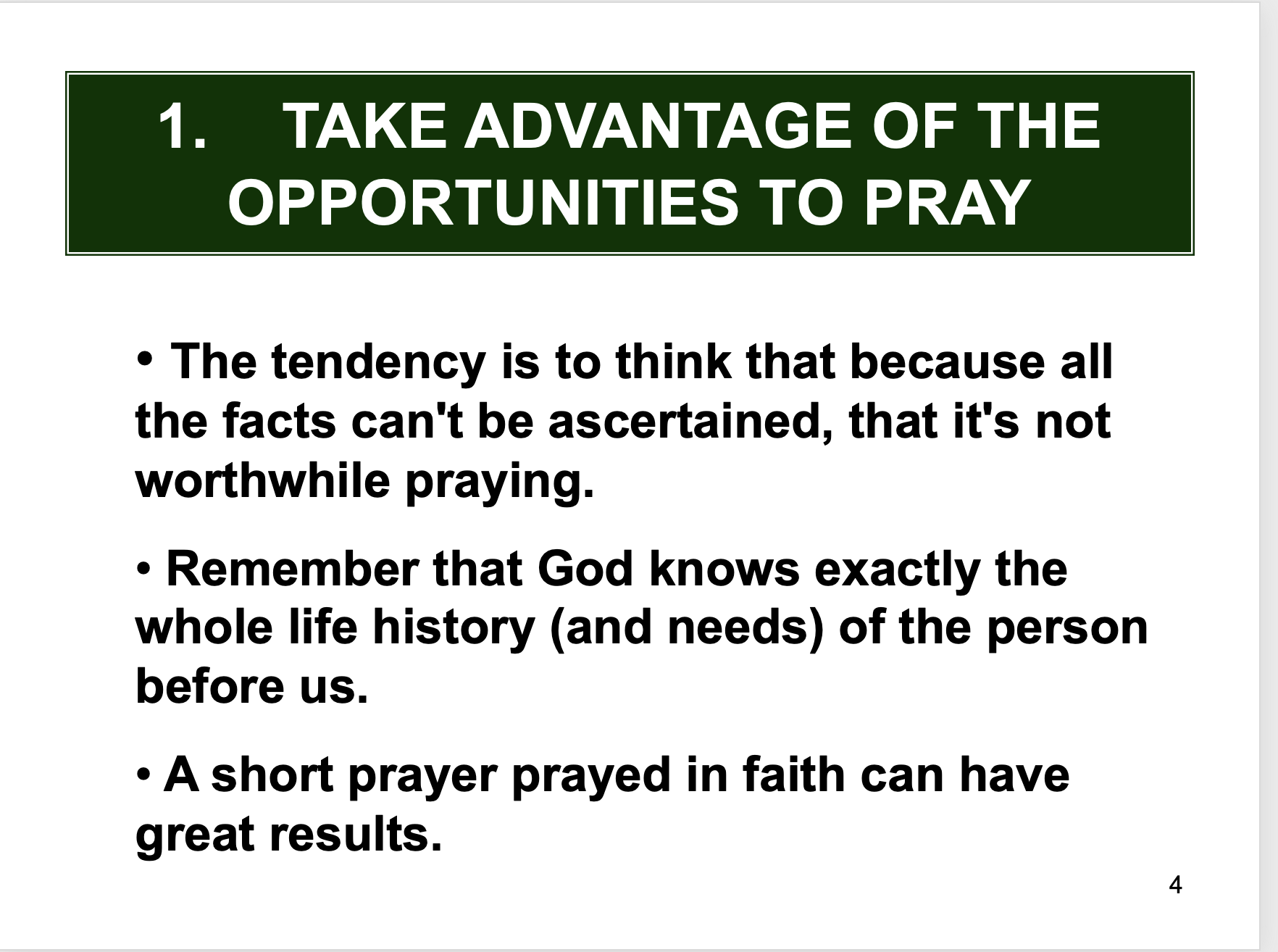
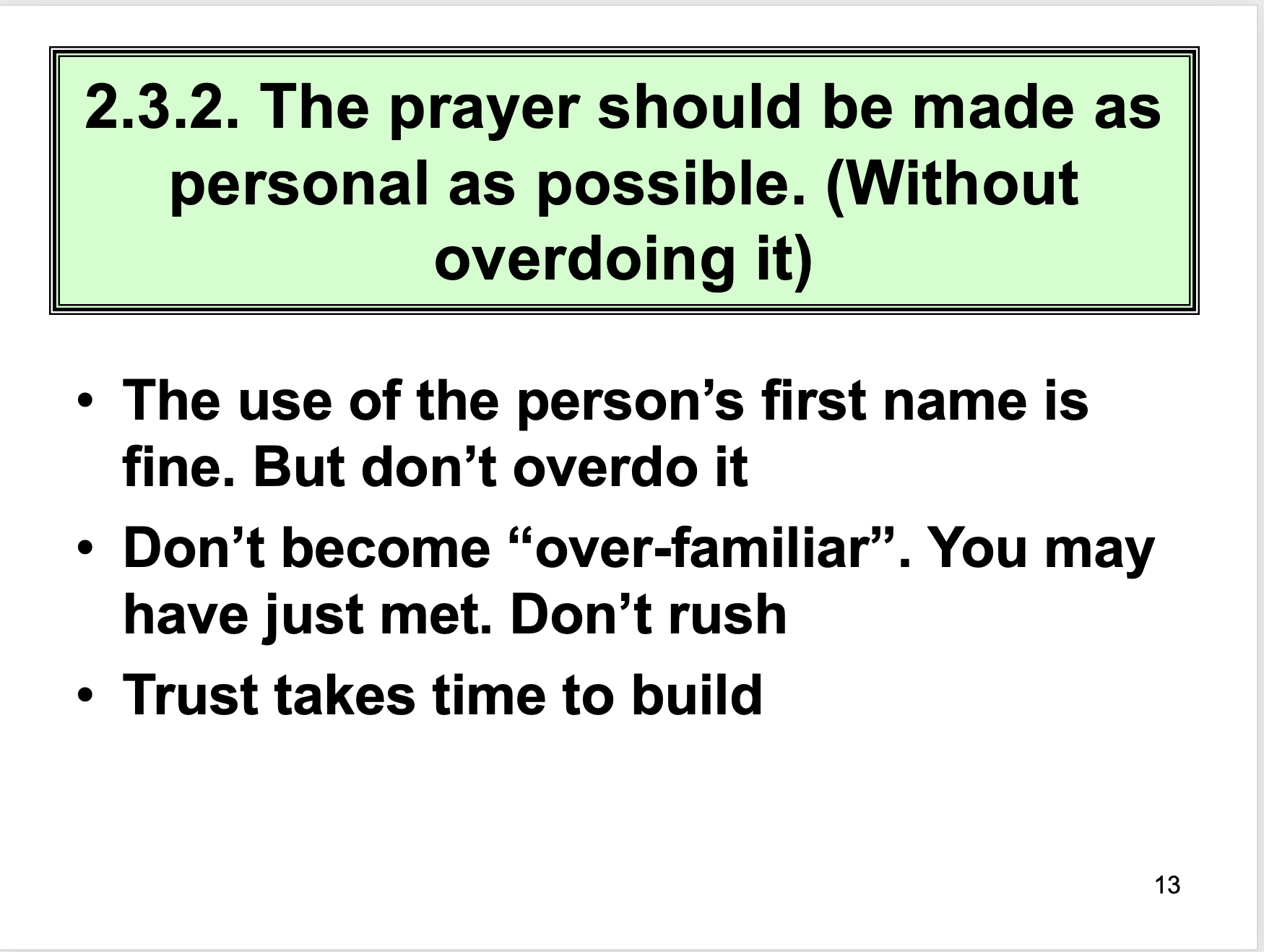
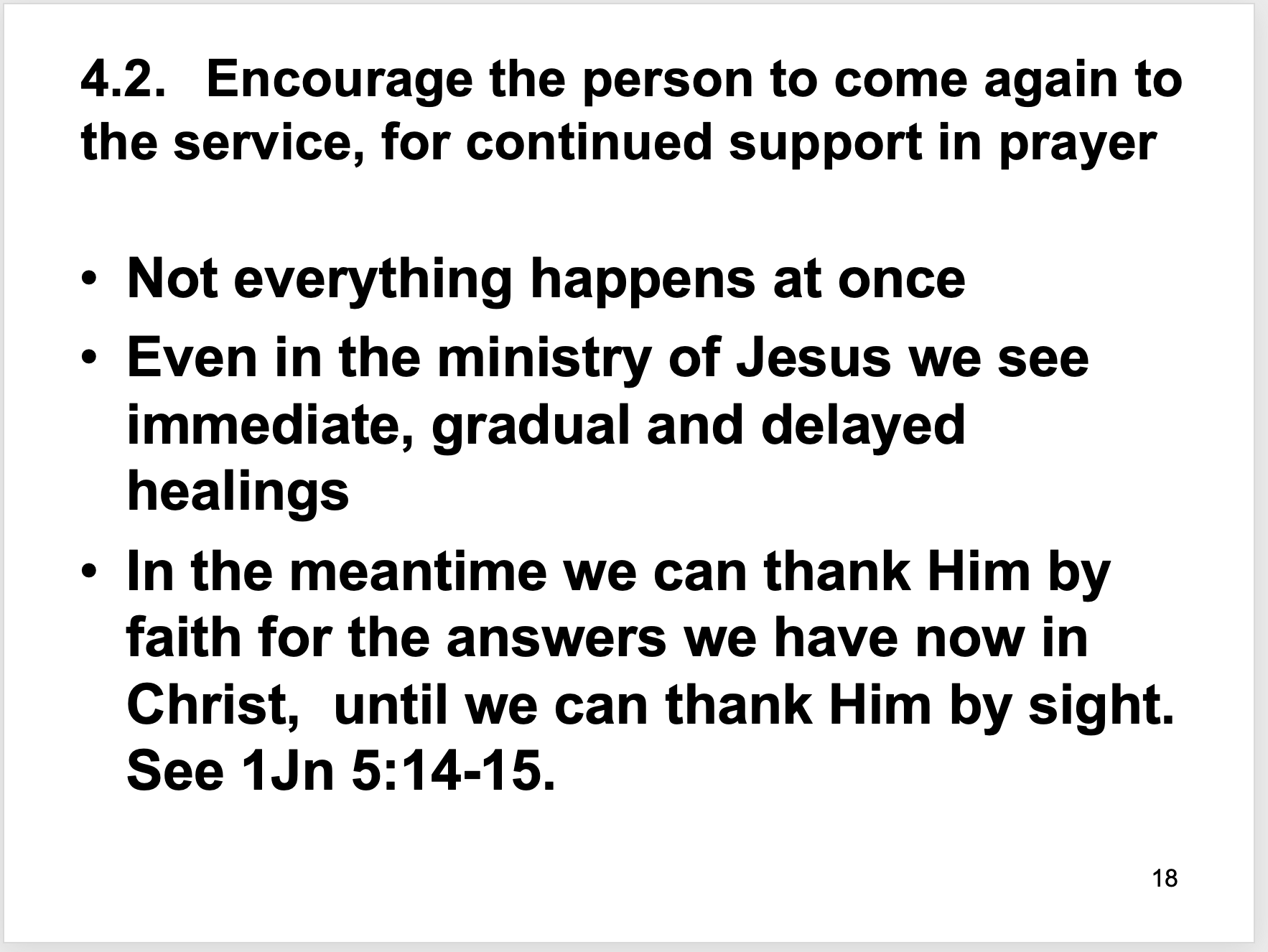
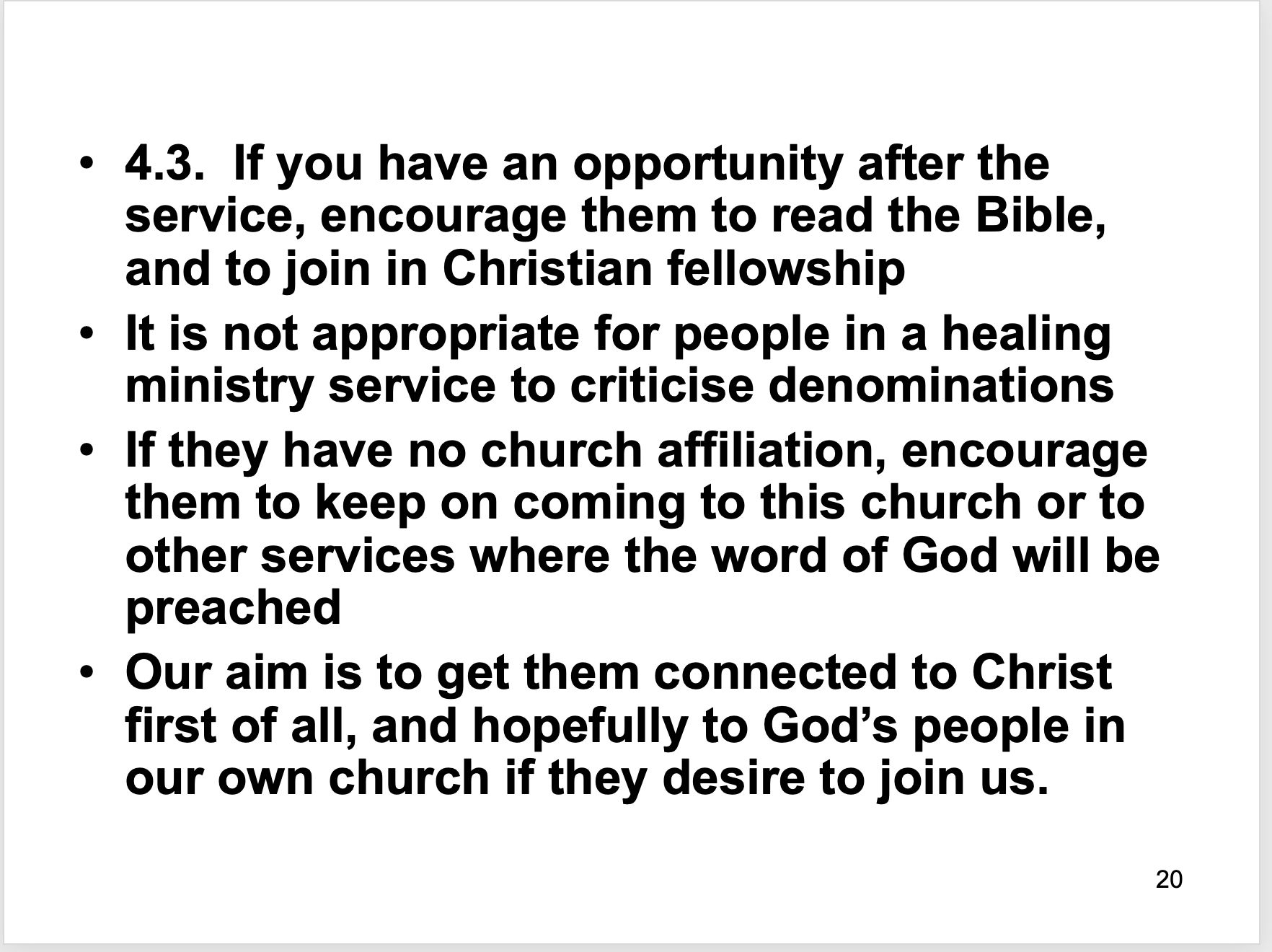
The following slide provides a scenario of what can happen when we fail to listen to the person we are trying to help. The pray-er thinks he has had some success while the person wanting help sees that the pray-er has lost the plot and is resigned to follow the pray-er’s approach, even though it is not covering their concerns.

Mat 18:19 “Again I say to you, if two of you agree on earth about anything they ask, it will be done for them by my Father in heaven. 20 For where two or three are gathered in my name, there am I among them.”

Often the person wanting prayer support may be unknown to us. We can’t as pray-ers become their best friend in a matter of minutes. But as we treat them and their concerns seriously, their trust in us can grow. It may be that eventually they say something like, “Look, the real reason I came for prayer is this.” Then they begin to share with us their deeper need.

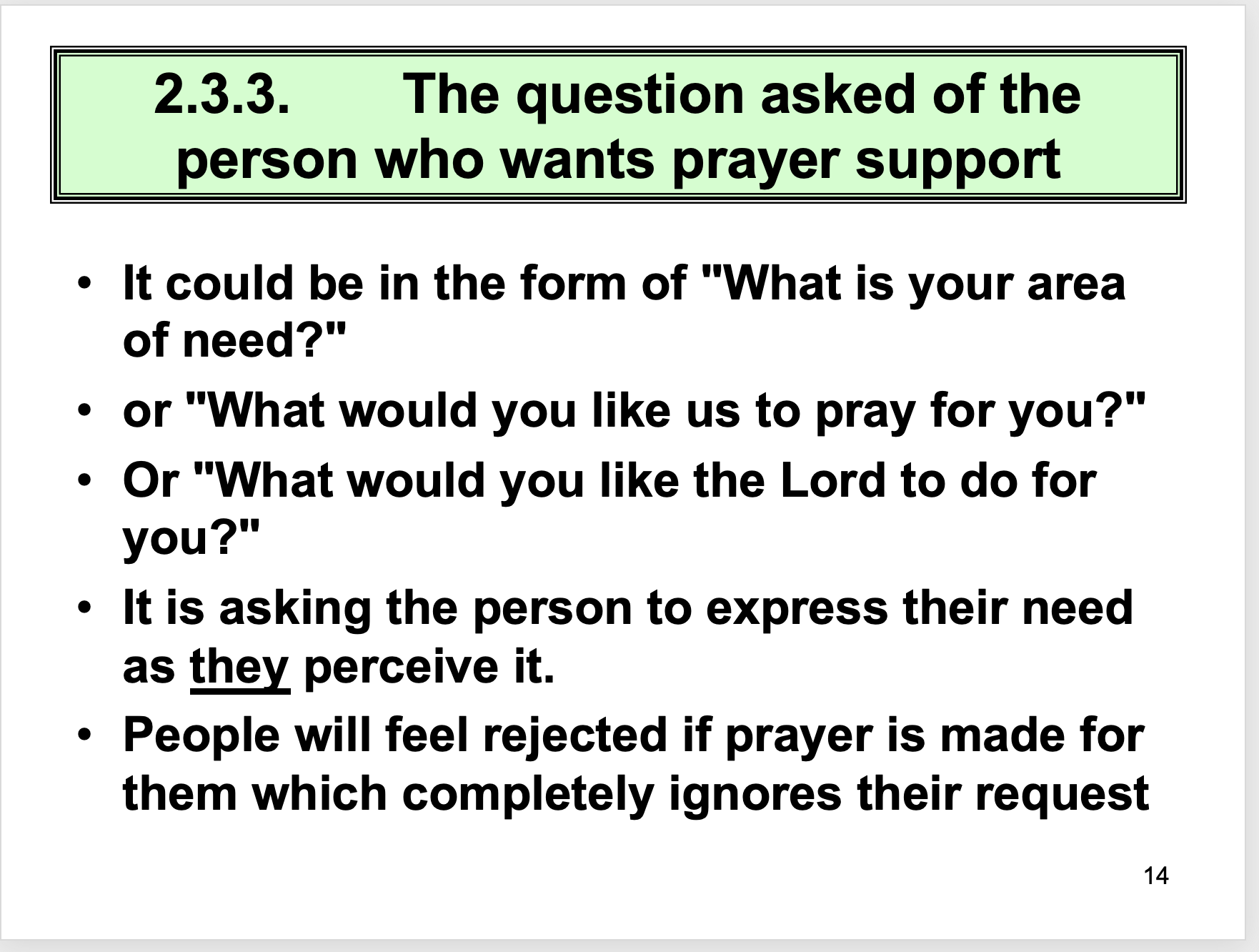
In 2.3.3 the best question to ask may be the third question, “What do you want the Lord to do for you?” It immediately reminds the pray-ers and the person wanting prayer support that it is the Lord Himself who is the healer. As James 5:15 puts it, “And the prayer offered in faith will make the sick person well; the Lord will raise them up. If they have sinned, they will be forgiven.” It is the Lord who answers believing prayer.

In 3.1we note that sometimes we notice changes in the way those coming to us for prayer speak about certain people. It may be that we notice their speech becomes quite bitter as they mention a certain person. It is not wise to say to them, ‘We noticed you became quite bitter when you mentioned that person’s name. Do you want us to pray for that bitterness to leave you?” They haven’t asked you to pray about bitterness and may feel that you are prematurely judging them. That doesn’t help when the person feels as though the pray-ers are being critical of them. Far better for the pray-ers to say at the end of the prayer time, “Is there anything else we can pray for you?” It may be that they then say, “Look, I have a real problem with bitterness. Would you pray for it to go from me?”

In 3.3 we realise that not every church congregation is familiar with audible tongues in prayer. Some ministers have inferred that tongues are not for today and may be demonic. The person who has come for prayer support may have been taught that untruth. So to pray in tongues audibly over such a person may invoke fear in them so that they want to get out of the building as soon as possible. As such it is counter-productive.

Posted in anointing, BIBLE PASSAGE OUTLINES, Bible verses. Comments, Evangelism, Faithfulness, Forgiveness, Glorification, Healing, Holy Spirit, Justification, Mental Health, New Covenant, Prayer, Questions and Answers, Salvation, Sanctification, spiritual warfare, Temptations, TOPICS | Tagged , , , , , , , , , , , , , , , , , | 1 Comment

483. The Good News Of A New Beginning. Joel chapter2

It is always great to get good news. Imagine how the people of Judah felt when they heard the message of Joel at the beginning of chapter 2. They were faced with really bad news about the devastation they were to face. But there was good news if they were to repent of their sins and turn back to God. Not only that but there was the promise of a future day of the Lord that would bring an incredible newness to the people of God.

The Bad News for Judah. A Day Of Disaster.

Their land was about to be invaded by a swarm of locusts which would bring terrible destruction on the land, “Blow a trumpet in Zion; sound an alarm on my holy mountain! Let all the inhabitants of the land tremble, for the day of the LORD is coming; it is near, 2  a day of darkness and gloom, a day of clouds and thick darkness! Like blackness there is spread upon the mountains a great and powerful people; their like has never been before, nor will be again after them through the years of all generations. 3  Fire devours before them, and behind them a flame burns. The land is like the garden of Eden before them, but behind them a desolate wilderness, and nothing escapes them.” Joel 2:1-3. Bad news indeed!

The Good News for Judah

But there was good news as well in Joel’s message. If the people were to repent of their sin and turn back to God then calamity might be averted. But their repentance needed to be sincere, from the heart,  “Yet even now,” declares the LORD, “return to me with all your heart, with fasting, with weeping, and with mourning; 13 and rend your hearts and not your garments.” 2:12-13

To Turn Back To The Gracious God Would Bring His Blessing 

“Return to the LORD your God, for he is gracious and merciful, slow to anger, and abounding in steadfast love; and he relents over disaster. 14  Who knows whether he will not turn and relent, and leave a blessing behind him, a grain offering and a drink offering for the LORD your God?” 2:13-14. A wonderful description of God’s character is given in these verses which echo those in Exodus 34:6-7 “The LORD, the LORD, a God merciful and gracious, slow to anger, and abounding in steadfast love and faithfulness, keeping steadfast love for thousands.”

The Good News Of Future Prosperity

God in His grace would be merciful to His people and would provide plentiful abundance for them and protection from their enemies,  “Then the LORD became jealous for his land and had pity on his people. 19  The LORD answered and said to his people, “Behold, I am sending to you grain, wine, and oil, and you will be satisfied; and I will no more make you a reproach among the nations. 20  “I will remove the northerner far from you, and drive him into a parched and desolate land, his vanguard into the eastern sea, and his rear guard into the western sea; the stench and foul smell of him will rise, for he has done great things. 21  “Fear not, O land; be glad and rejoice, for the LORD has done great things!” 2:18-21.

Restoration Of Missed Blessings And Prosperity

Human sin restricts the fulness of the blessings God wants to bestow on His people. But here God promises the restoration of those blessings,  “I will restore to you the years that the swarming locust has eaten, the hopper, the destroyer, and the cutter, my great army, which I sent among you. 26  “You shall eat in plenty and be satisfied, and praise the name of the LORD your God, who has dealt wondrously with you. And my people shall never again be put to shame. 27  You shall know that I am in the midst of Israel, and that I am the LORD your God and there is none else. And my people shall never again be put to shame.” 2:25-27. How wonderful it is to know that our God can restore to us what we have lost in the past. He can even deal with the shame we have felt from our past!

A Prophecy Of God’s Blessing That Would Transform Peoples Of All Nations

The book of Joel may not have been quoted much in the rest of the Bible but in its single mention it was highly significant. St Peter quoted the words which follow in chapter 2, to describe the momentous event on the Day of Pentecost as the Holy Spirit was poured out on the infant church, “And it shall come to pass afterward, that I will pour out my Spirit on all flesh; your sons and your daughters shall prophesy, your old men shall dream dreams, and your young men shall see visions. 29  Even on the male and female servants in those days I will pour out my Spirit.”  2:28-29.  

On that most significant day St Peter explained what God had done in pouring out His Spirit on all the believers. It was a fulfilment of the prophecy of Joel given several hundred years before. Let’s see how St Peter described it in Acts 2, “But Peter, standing with the eleven, lifted up his voice and addressed them: “Men of Judea and all who dwell in Jerusalem, let this be known to you, and give ear to my words. 15  For these people are not drunk, as you suppose, since it is only the third hour of the day. 16  But this is what was uttered through the prophet Joel: 17  “‘And in the last days it shall be, God declares, that I will pour out my Spirit on all flesh, and your sons and your daughters shall prophesy, and your young men shall see visions, and your old men shall dream dreams; 18  even on my male servants and female servants in those days I will pour out my Spirit, and they shall prophesy. 19  And I will show wonders in the heavens above and signs on the earth below, blood, and fire, and vapour of smoke; 20  the sun shall be turned to darkness and the moon to blood, before the day of the Lord comes, the great and magnificent day. 21  And it shall come to pass that everyone who calls upon the name of the Lord shall be saved.” Acts 2:14-21. St Peter in his address quoted almost the whole of the prophecy from Joel chapter 2 and St Luke [who wrote The Acts Of The Apostles] recorded Peter’s words in his book. 

We may wonder today if Joel understood the magnitude of the prophecy he had written. St Peter wrote generally about the understanding the prophets had of their messages, “Concerning this salvation, the prophets who prophesied about the grace that was to be yours searched and inquired carefully, 11  inquiring what person or time the Spirit of Christ in them was indicating when he predicted the sufferings of Christ and the subsequent glories. 12  It was revealed to them that they were serving not themselves but you, in the things that have now been announced to you through those who preached the good news to you by the Holy Spirit sent from heaven, things into which angels long to look.” 1 Peter 1:10-12. 

What is amazing about this prophecy of Joel’s in chapter 2 is the description of the exact nature of the events of Pentecost, some several hundred years in the future. He prophesied that the Holy Spirit would be “poured out” and significantly, it would be upon all flesh, not just upon prophets, priests and kings and a few others as what happened in the Old Testament time in which he lived. “Poured out” in the Greek Old Testament is [ekcheō, ἐκχέω] and St Luke uses the same word in Acts 2:33, “He has poured out this that you yourselves are seeing and hearing.

The final part of Joel’s prophecy in chapter 2 was quoted exactly by St Peter on the day of Pentecost, “And it shall come to pass that everyone who calls upon the name of the Lord shall be saved.” Acts 2:21. It is interesting that Joel and St Peter both see those who receive the Holy Spirit as those whom the Lord calls to Himself. Joel expresses it as, “For in Mount Zion and in Jerusalem there shall be those who escape, as the LORD has said, and among the survivors shall be those whom the LORD calls.” 2:32. St Peter expressed it as, “For the promise is for you and for your children and for all who are far off, everyone whom the Lord our God calls to himself.” Acts 2:39. The verb used in both verses in the Greek translations is the word [proskaleomai, προσκαλέομαι] meaning to call to oneself. It is humbling to realise that those who call upon the Lord are those whom the Lord has been calling to Himself. No wonder that salvation is from the grace of God.

Blog No.483 posted on Saturday 03 June 2023.

Posted in BIBLE PASSAGE OUTLINES, Bible verses. Comments, Creation, Evangelism, Faithfulness, Forgiveness, Healing, Holy Spirit, Judgement, Justification, Mental Health, New Covenant, Prayer, Salvation, Sanctification, Second coming of Jesus, Temptations, TOPICS | Tagged , , , , , , , , , , , , | Leave a comment

482. Difficulties Should Lead Us To Repentance. Joel chapter 1

Joel received the word of the Lord and shared it with all the people of Judah. In verses 1:1-4 he addressed the elders and all the people of the land and intimated that the destruction wrought by successive waves of locusts had been allowed to happen by their God. 

He then warned those associated with wine, such as the drunkards and those who drank wine, that they needed to become awake. “Awake, you drunkards, and weep, and wail, all you drinkers of wine, because of the sweet wine, for it is cut off from your mouth.” 1:5.

The locusts had come like a hostile nation and had invaded the land and destroyed the vegetation, “For a nation has come up against my land, powerful and beyond number; its teeth are lions’ teeth, and it has the fangs of a lioness. 7  It has laid waste my vine and splintered my fig tree; it has stripped off their bark and thrown it down; their branches are made white.” 1:6-7.

His advice was for them to be sorrowful “Lament like a virgin wearing sackcloth for the bridegroom of her youth.” 1:8. They were to be filled with a deep sense of loss. 

The priests and the ministers of the LORD were to mourn because no more offerings could be made, “The grain offering and the drink offering are cut off from the house of the LORD. 10  The fields are destroyed, the ground mourns, because the grain is destroyed, the wine dries up, the oil languishes.”  1:9-10.

The tillers of the soil; and the vinedressers were to be ashamed and to wail, for everything from which they could expect a harvest had dried up and perished. Joel adds, “and gladness dries up from the children of man.” The picture is of utter devastation and the loss of any joy in the situation. 1:11-12. 

A Call to Repentance

Joel went on to explain that God was behind the disasters so the people had to repent. It is interesting though that Joel does not express the nature of their sin.  He just urges the priests and ministers of the altar to put on sackcloth and lament, for grain and drink offerings had been withheld from the house of their God. They were also to consecrate a feast and to call a solemn assembly. The elders and all the inhabitants of the land were to gather to the house of the LORD and cry out to the LORD. 1:14.

There was a need for the nation to repent, for something worse was to happen. Joel expresses it in 1:15  “Alas for the day! For the day of the LORD is near, and as destruction from the Almighty it comes.” The day of the Lord is a major theme in Joel and was seen as a day of destruction. He reminds them of their present plight, “Is not the food cut off before our eyes, joy and gladness from the house of our God? 17  The seed shrivels under the clods; the storehouses are desolate; the granaries are torn down because the grain has dried up. 18  How the beasts groan! The herds of cattle are perplexed because there is no pasture for them; even the flocks of sheep suffer.” 1:16-18. The devastation affected not only the land, but even the animals used to grazing on the land were distressed because there was no pasture for them. The coming day of the Lord would bring even greater disaster so repentance was needed.

Joel then joins in crying out to the Lord, “To you, O LORD, I call. For fire has devoured the pastures of the wilderness, and flame has burned all the trees of the field. 20  Even the beasts of the field pant for you because the water brooks are dried up, and fire has devoured the pastures of the wilderness.” There was utter devastation in the land and even the animals panted for God in their thirst. 

The whole of chapter 1 is a description of what God had allowed to happen to the nation and contained warnings to all the people to cry out to the Lord for mercy before the coming day of the Lord arrived. 

What lessons can we learn from Joel chapter 1?

It reminds us that God’s people need to be living in the way He wants them to live and not simply doing their own thing in life. God has placed Himself in a covenant with His people to protect and bless them but they need to remain faithful to Him. If they begin to stray and fail to live up to their commitment to Him and to His will, He may have to bring correction. 

This is not His punishment as such but His concerned discipline. His discipline has a purpose. As the writer to the Hebrews put it, “… but he disciplines us for our good, that we may share his holiness. 11 For the moment all discipline seems painful rather than pleasant, but later it yields the peaceful fruit of righteousness to those who have been trained by it.”  Hebrews 12:10-11. God’s discipline always has a positive purpose. It is to help His people return to Him to become more like Him by His grace.

WE also learn that God wants all His people to be open to Him and to repent when they stray from His ways. When they are not cognisant that they are living apart from His blessing, He may have to exercise greater discipline to get them to realise their sin and to return to Him in repentance.  

St Paul saw the value of the stories in the Old Testament [such as Joel chapter 1] as being instructive for believers in all ages, “Now these things happened to them as an example, but they were written down for our instruction, on whom the end of the ages has come.” 1 Corinthians 10:11.

May we learn the lessons from Joel chapter 1 so that we maintain a close relationship with our heavenly Father and not have to endure His discipline. 

Blog No.482 posted on Friday 26 May 2023. 

Posted in Bible verses. Comments, Evangelism, Faithfulness, Forgiveness, Healing, Holy Spirit, Judgement, Justification, Mental Health, Prayer, Salvation, Sanctification, Second coming of Jesus, Temptations, TOPICS | Tagged , , , , , , , , , , , , | Leave a comment

481. Ephesians 1:15-23. “Knowing The Power Of God In Our Lives.”

We live in very difficult times. It seems to be a topsy-turvy world in which values are being reversed and what was once called evil is being called good and the good is being called evil. It is a time in which we need to pray for one another, to experience the best that this life has to offer.

St Paul realised that his Christian converts needed to be prayed for. So in Ephesians 1:15-23 he told the believers in Ephesus what he was praying for them. It shows how we can pray for another today.

THE NEED TO PRAY FOR ONE ANOTHER TO KNOW GOD BETTER. 1:15-17

Eph 1:15  “For this reason, ever since I heard about your faith in the Lord Jesus and your love for all God’s people, 16  I have not stopped giving thanks for you, remembering you in my prayers. 17 I keep asking that the God of our Lord Jesus Christ, the glorious Father, may give you the Spirit of wisdom and revelation, so that you may know him better.” [NIV].

There’s only one thing better than knowing God. That is, that we might know Him better! To have a deeper relationship with him. To have a deeper commitment to Him.

WHAT TO PRAY FOR ONE ANOTHER. THAT WE MIGHT KNOW 3 THINGS. 1:18-21

Eph 1:16  “I do not cease to give thanks for you, remembering you in my prayers, that the God of our Lord Jesus Christ, the Father of glory, may give you the Spirit of wisdom and of revelation in the knowledge of him, 18  having the eyes of your hearts enlightened, that you may know 

  • what is the HOPE to which he has called you, 
  • what are the RICHES of his glorious inheritance in the saints, 
  • 19 and what is the immeasurable greatness of his POWER toward us who believe.

He wants them to know… Their HOPE. Their RICHES in Christ. The POWER they had in Christ. 

1].  THE HOPE TO WHICH HE HAS CALLED YOU.

In our culture, the word “hope” doesn’t have quite the same meaning as the word in the New Testament Greek. We use hope to describe what we would like to happen. For example, we hope to one day get married, if we can find someone silly enough or wise enough to marry us. Or we say we hope it will be fine next weekend. But there’s always a certain amount of uncertainty involved with it in the way we use it.

But there was no uncertainty involved with the way it was used in the NT. Hope meant something that was assured, something that would certainly come to pass. Nothing could prevent it.

Christian hope doesn’t mean that we become X’ians and then hope that one day we’ll go to heaven. 

  • No! Our Christian hope means that as Christians we’re assured of one day entering into the presence of our Heavenly Father. 
  • There’s no doubt about it at all. This is something God has promised to us in His grace.
  • We can know that we are right with God and that when we breathe our last breath, we will be immediately in the presence of God. 
  • That truth became immensely comforting for me in October 2019. I had been visiting my beloved wife Carole in the Palliative Care Ward of the hospital in Wauchope. She was dying of terminal cancer and had not responded at any time during the day I spent with her. As I left her to drive home, I kissed her and prayed that God might do a miracle if that was His will, and restore her to health and strength. As I walked out of the ward I turned to see if God had worked a miracle, but she lay there motionless. I was home less than couple of hours when the phone rang. It was the hospital ringing to say that Carole had passed away just a couple of minutes before. It was heartbreaking to hear that the beautiful woman who had been my best friend for over 60 years and to whom I had been married in a wonderful marriage for 54 years, had passed away. As I put the phone down, I felt empty and deeply saddened wondering how I could cope without my best friend and the woman I had loved for almost 60 years. Suddenly these words came into my mind, “Absent from the body, present with the Lord.” [2 Cor 5:8.] I realised afresh that Carole was now in the bliss in the presence of Jesus and that I had been able to love her until Jesus took her home.
  • The same words of assurance came to my mind when I heard that our dear friend David Curtis had passed away after being struck by a vehicle on a pedestrian crossing in Port Macquarie. He too was now “absent from the body and present with the Lord.”

2].  THE RICHES OF HIS GLORIOUS INHERITANCE IN HIS HOLY PEOPLE,

When we give our lives to the Lord, we become the heirs of God, and fellow-heirs with Christ.  [Romans 8:17.] Or “For all things are yours, whether Paul or Apollos or Cephas or the world or life or death or the present or the future—all are yours, and you are Christ’s, and Christ is God’s. When we become Christians we become open to receive all the things that God has promised His people. They are riches, or as Paul writes elsewhere, they are the “unsearchable riches in Christ”  Riches that can never be exhausted by anyone within a lifetime. [Ephesians 3:8.]

There’s been a lot of argument in the church this century as to whether there is a second blessing beyond our conversion experience.  

  • I personally believe there IS a second blessing, 
  • AND a 3rd  AND a 4th , and a 1000th   blessing.
  • In other words, our whole spiritual pilgrimage will be spent discovering more and more of those unsearchable riches in Christ. 

I cringe every time I hear anyone say they have had the second blessing. Why should anyone stop there?  We can never ever say that we’ve arrived spiritually at a stage where there is nothing more to learn, nothing more to experience.

But God is always beyond the limits of our experience.  His unsearchable riches will never be appropriated by any individual or by any denomination, or by any movement within the church.  

3].  EPH 1:19- 21.  AND HIS INCOMPARABLY GREAT POWER FOR US WHO BELIEVE.

“That power is the same as the mighty strength 20  he exerted when he raised Christ from the dead and seated him at his right hand in the heavenly realms, 21  far above all rule and authority, power and dominion, and every name that is invoked, not only in the present age but also in the one to come.”

There are many Christians today who are very sensitive about any mention of power.  But the Bible isn’t reticent about mentioning power. Notice what Paul says about power here. 

  • It is beyond measurement. It is megatos or megaton power, exceedingly great. 
  • It is the power God used in raising Jesus from the dead, and in seating Him at His right hand in glory. 
  • It is this sort of power which is “in us who believe.”

This is the humbling part. That you and I will only be able to experience anything of God’s power, when we become utterly weak. As Paul wrote, “God’s strength is made perfect in weakness.

Paul later wrote in this same letter that God is able to do immeasurably more than all we ask or imagine, according to His power that is at work within us..” (3:20.) I’ve seen something of the dimension of that power in the transformation of individuals, yet I know there infinitely more power available for us to tap into.

Paul finishes his prayer with the reminder that the risen Christ is the One in absolute authority in the church and in the world. But it’s an authority that has to be personally submitted to. In other words, for Christ to be the Lord of our lives, we need to submit ourselves to His rule over us. It’s not automatic. It needs a step of faith to say to the Lord, “Lord I want you to become the Lord and Master of my life, so that You can do in me and through me what you desire. I crown you as the Lord of my life.” It’s a step we all need to take!

But what about us in May 2023? How do we stand before God? 

In Ephesians 2 verses 1 and 3 Paul writes that the whole human race is dead in sin and that we are deserving of God’s wrath. We are sinners  facing the judgment of God. Not good news but absolutely true!

BUT WAIT! There is good news!  We can be set free from God’s wrath and judgment. Eph 2:4-6. “But because of his great love for us, God, who is rich in mercy, 5  made us alive with Christ even when we were dead in transgressions—it is by grace you have been saved. 6  And God raised us up with Christ and seated us with him in the heavenly realms in Christ Jesus.”

  • He made us spiritually alive with Christ. Once we were spiritually dead, but now we have become spiritually alive with Christ.
  • When God raised Jesus from the dead and He ascended into heaven, He raised us up with Christ and seated us with him in the heavenly realms in Christ Jesus.”
    • Seated in Christ, in the place of acceptance with God.  [You can never be more accepted by God than when you receive Christ as Saviour. More useful to Him, yes!]
    • Seated in Christ in the place of authority over the powers of darkness
    • Seated in Christ in the place of power over the world, the flesh and the devil.

So as God looks upon us today, He sees us in 2 ways

  • He sees us Geographically as being seated in this building [between Hay & Murray streets, Port Macquarie.]
  • He sees us Spiritually. He sees some of us being seated in Christ at the right hand of God. Everyone else being “outside of Christ.” 

How can we become among those who are “in Christ?” [No longer under the judgment of God?]

It was a question I was facing on New Year’s Eve 1958. I knew I wasn’t a believer. I knew I had to get right with God. But how?

  • As I wandered through the streets of Tweed Heads-Coolangatta about 11pm I knew I wanted to get right with God, and I remembered a prayer of commitment I had seen in a little booklet by the Rev John Stott. It was based on 4 letters of the alphabet. A,B,C and D.
  • A.        I had to Admit I was a sinner in the sight of God. [Sins of commission and of omission.]
  • B. I had to Believe that Jesus died on the cross for me to be forgiven.
  • C.        I had to Consider the Cost of  becoming a Christian. It would Cost nothing, “For God so loved the world, that he gave his only Son, that whoever believes in him should not perish but have eternal life.John 3:16. Salvation is a free gift in Christ. But it would cost me everything. I would have to give up living my way, and learn to live God’s way in Christ. As St Paul wrote, “and he died for all, that those who live might no longer live for themselves but for him who for their sake died and was raised.2 Corinthians 5:15.
  • D. I had to Do something about it.  I had to invite Him into my life to be my Saviour and Lord. 

AND I had learned how to invite Him into my life in Rev 3:20 where Jesus said, “Behold, I stand at the door and knock. If anyone hears my voice and opens the door, I will come in to him and eat with him, and he with me.”

It’s the picture of Jesus standing at the door of the hearts of individual people in the church in Laodicea, knocking and asking to come into their hearts. They had to deliberately open the door of their hearts to Him.

So just before midnight, I knelt down and prayed the prayer and opened my life to Jesus. He entered my life and I entered 1959 as a brand-new creation in Christ and life really began from that moment. I had come from spiritual death to be spiritually alive. Christ was now my Saviour from sin and I had made Him Lord of my whole being. 

The Good News is that you can leave this building today knowing that you are right with God and that if you were to die this afternoon or in 70 years time, you would wake up in bliss in the presence of Jesus. 

Today we celebrate Ascension Day, the day Jesus ascended into heaven. There He received the promised Holy Spirit whom He poured out on His disciples on the day of Pentecost and whom He now pours out on all who trust in Jesus as Saviour and Lord. That’s what He wants to happen in every person ever born!

Let’s allow Him to do that on us today as we pray, so that His Spirit can open blind eyes that they may see to believe.     

You can become a believer, someone in Christ, a child of God as you pray this prayer. A,B,C,D. You can pray it with me as I pray,

A].  Lord, I Admit I am a sinner in Your sight.

B].  I Believe Christ died for me on the cross.

C].  I have Considered the Cost of becoming a believer. It costs me nothing, but I know it costs me everything as I have now live for you for every moment of my life.

D]. I need to Do something about it. I now open the door of my life to You Jesus. Come into my life Lord Jesus.”

“Thank You Lord Jesus for coming into my life to be my Saviour. I now enthrone You as the Lord and Master of every part of my life. AMEN!” 

If you have prayed the prayer you need to tell someone you trust. 

StPaul wrote in Rom 10:9, “if you confess with your mouth that Jesus is Lord and believe in your heart that God raised him from the dead, you will be saved.”

Having prayed this prayer, you can leave this building today knowing that whenever you die, you will go to be with Jesus in Paradise. 

Blog No.481 posted on Wednesday 24 May 2023.

Posted in BIBLE PASSAGE OUTLINES, Bible verses. Comments, Coping With Personal Grief, Evangelism, Faithfulness, Forgiveness, Glorification, Healing, Holy Spirit, Judgement, Justification, Mental Health, OUTLINE OF EPHESIANS, Prayer, Praying our way through Paul's letter to the Ephesians, Real Life Stories, Salvation, Sanctification, Temptations, TOPICS | Tagged , , , , , , , , , , , , , , , , | 3 Comments

480. Jonah 4. Having The Right Motivations In Life

Chapter 3 of Jonah ends with these words, “When God saw what they did, how they turned from their evil way, God relented of the disaster that he had said he would do to them, and he did not do it.” 3:10.

It meant that the ministry of Jonah as a prophet sent by God to warn the people of Nineveh had been an outstanding success. The whole city including the king had believed God’s message and had turned from their sin. Their response to Jonah’s message meant they averted God’s judgment. 

It is quite surprising that the next verse in chapter 4 of Jonah has these words, “But it displeased Jonah exceedingly, and he was angry.” 4:1.

Why would the prophet of God be angry when the people repented upon hearing his message so that God relented of His plan to destroy Nineveh? 

God Desires Good Motivations In His Servants. To have a heart like His

It seems that Jonah’s motivations were at odds with the heart and mind of God. We see that in the way he addressed God in prayer, “And he prayed to the LORD and said, “O LORD, is not this what I said when I was yet in my country? That is why I made haste to flee to Tarshish; for I knew that you are a gracious God and merciful, slow to anger and abounding in steadfast love, and relenting from disaster.” 4:2.

Jonah had a serious problem. He was a prophet chosen by God to take His message to people. BUT he had a distorted view of what God should be like. He saw him as being “a gracious God and merciful, slow to anger and abounding in steadfast love, and relenting from disaster.” 4:2. That was a true picture of the character of God, but Jonah wanted Him to be different, to not be gracious, to not be merciful and wanting Him to bring disaster on the people of Nineveh. When God relented of bringing the disaster on Nineveh, Jonah got really angry. He told God that was the reason he fled from delivering God’s message initially because he was hoping the people of Nineveh would reject the message and disaster would come upon them. How sad that a prophet of God could wish to have a vengeful Master to obey. When the disaster did not happen, Jonah was shattered. He had a death wish for himself, “Therefore now, O LORD, please take my life from me, for it is better for me to die than to live.” 4:3. He was angry that God’s gracious will had prevailed and that what he wanted to happen, didn’t. 

The Lord Questioned Jonah’s Motivation

 The question, “Do you do well to be angry?” is relevant for God’s people at any time. Can any believer ever resent God’s compassion on anyone, including their enemies? It was a question Jonah had to ponder. In the meantime, Jonah would go outside the city to see what God would do, “Jonah went out of the city and sat to the east of the city and made a booth for himself there. He sat under it in the shade, till he should see what would become of the city.” 4:5.

The Gracious Lord Acted Graciously For The Downcast Prophet

Jon 4:6 “Now the LORD God appointed a plant and made it come up over Jonah, that it might be a shade over his head, to save him from his discomfort. So Jonah was exceedingly glad because of the plant.”

As Jonah sits waiting hopefully for God to bring disaster on the people of Nineveh, God takes the time to make life more bearable for Jonah. 

The plant the Lord provided would comfort Jonah in his discomfort while Jonah sits waiting for the city to be destroyed. What a difference in their view of the people of Nineveh. The Lord waiting for the people to repent, while Jonah is hoping they don’t repent and thus would suffer judgment. 

God Teaches Jonah A Lesson About Life

One wonders if Jonah would ever humble himself to want God’s will to be done rather than what he personally wanted.  God had another lesson to teach His unruly prophet, “But when dawn came up the next day, God appointed a worm that attacked the plant, so that it withered. 8  When the sun rose, God appointed a scorching east wind, and the sun beat down on the head of Jonah so that he was faint. And he asked that he might die and said, “It is better for me to die than to live.”4:7-8.

God destroyed the plant He had provided for Jonah’s comfort, and the sun and the scorching wind brought great physical distress to him. He was also angry that the plant had died. God challenged Jonah again with the same words as before,“ But God said to Jonah, “Do you do well to be angry?” [for the plant] ” And he said, “Yes, I do well to be angry, angry enough to die.” 4:9. He was angry that the plant that gave him relief from his discomfort had died.

God Teaches Jonah A Lesson About Love

God challenged Jonah about the contrast in their attitude to the people of Nineveh,  “And the LORD said, “You pity the plant, for which you did not labour, nor did you make it grow, which came into being in a night and perished in a night.” 4:10. Jonah had concern for the plant which he had done nothing to create and only lasted for a short time. 

Then the Lord rebuked Jonah by showing the contrast He had in His attitude to the people of Nineveh.  “And should not I pity Nineveh, that great city, in which there are more than 120,000 persons who do not know their right hand from their left, and also much cattle?” 4:11.

The contrast was obvious. Jonah had no real concern for the lives of thousands of people who were facing disaster, many of whom were very young. His focus was on his own needs. He longed for the comfort of a small piece of vegetation that God had provided in his mercy for Jonah and when it died he was angry. But it was a plant, not a person. 

On the other hand, God had created not only the plant to bring comfort to Jonah but He had also created all the thousands of people including innocent children and all the animals in Nineveh. He didn’t want them to face disaster. He wanted them to turn from their evil ways. That was why He had sent His prophet to Nineveh with a message for them to turn from evil lest He be forced to destroy them. 

Perhaps Jonah eventually saw the error of his misunderstanding of the value that God had placed on people, even those who were rebelling against His ways. If Jonah actually wrote the book, he tells the whole story warts and all in describing the compassion God has on all the peoples of the world and the lessons God taught him. 

The story of the book of Jonah is relevant for today 

It shows the value the Lord has on all peoples even those who have no deep knowledge of Him and His ways. He knows they all face destruction unless they repent of their sins and turn to Him to be saved. So He has commanded His people to take the gospel message of His love to all parts of the world. The “gospel in a nutshell” as someone once wrote, reminds us of that, “For God so loved the world, that he gave his only Son, that whoever believes in him should not perish but have eternal life. 17  For God did not send his Son into the world to condemn the world, but in order that the world might be saved through him. John 3:16-17. Or as Peter wrote in 2 Peter 3:9, “The Lord is not slow to fulfil his promise as some count slowness, but is patient toward you, not wishing that any should perish, but that all should reach repentance.” God hates sin but loves sinners so much that He made it possible for even the worst sinners to be forgiven. All they need to do is to repent of their sins and receive salvation freely by accepting Christ as their Saviour and Lord.

God knows His world and the hearts of every individual in it. He wants them all to live and not die in their sins. He has made it possible for everyone to be saved, for the blood of Jesus shed on the cross can cover the sins of the whole world. But that salvation, that forgiveness is only to be found in Jesus whom He sent into the world to be its Saviour from sin. 

Jesus certainly used the story of Jonah to bring a warning to the people of Israel when He preached.  In Matthew 12:41 He said,  “The men of Nineveh will rise up at the judgment with this generation and condemn it, for they repented at the preaching of Jonah, and behold, something greater than Jonah is here.” If the people of the evil foreign city of Nineveh could repent of their evil deeds and turn to God for salvation when God warned them, then how much more should the Jews of Jesus’ day repent and turn to God as they listened to one of their own, not just a prophet, but to One who was the Son of God and the Saviour of the world. 

Blog No.480. Posted on Wednesday 10 May 2023. 

Posted in BIBLE PASSAGE OUTLINES, Bible verses. Comments, Creation, Evangelism, Faithfulness, Forgiveness, Healing, Holy Spirit, Judgement, Justification, Mental Health, Prayer, Real Life Stories, Salvation, Sanctification, Temptations | Tagged , , , , , , , , , , , , , , , | Leave a comment

479. Obedience To God Brings His Blessings. Jonah 3

Jonah was certainly a reluctant prophet. He was commanded by God to go to Nineveh and warn them that if they did not turn from evil, disaster would come upon the whole city.  However, Jonah arose and went in the opposite direction in an act of sheer disobedience to God. He boarded a ship to get away from God. 

God dealt dramatically with Jonah as He caused a violent storm to arise so that the ship began to sink. He was thrown into the sea and was swallowed by a great fish. In the mercy of God, Jonah repented of his sin and cried out to God to be saved.  The great fish [at God’s command] then vomited Jonah out onto dry land. 

The Opportunities Given By Second Chances. 3:1-3

1 “Then the word of the LORD came to Jonah the second time, saying, 2 “Arise, go to Nineveh, that great city, and call out against it the message that I tell you.” 

It’s wonderful to know that God doesn’t give up on us when we disobey Him. In the story we read how God spoke to his prophet Jonah again and recommissioned him for the task of taking His message to the people of Nineveh. When God first called Jonah his response was disobedience, “But Jonah rose to flee to Tarshish from the presence of the LORD.” Jonah 1:3. However God had dealt with Jonah so that at this second call, his response was different, “So Jonah arose and went to Nineveh, according to the word of the LORD. Now Nineveh was an exceedingly great city, three days’ journey in breadth. 4 Jonah began to go into the city, going a day’s journey. And he called out, “Yet forty days, and Nineveh shall be overthrown!” Jonah 3:3-4.

We see in the story, God’s persistence in getting Jonah to take His message to the people in Nineveh. We also see His compassion for those in Nineveh as He did not want to have to destroy them. He wanted them to repent and give up their evil ways. As another Jonah [Simon Bar-Jonah] wrote, “The Lord is not slow to fulfil his promise as some count slowness, but is patient toward you, not wishing that any should perish, but that all should reach repentance.” 2 Peter 3:9.

God’s Message Brought Freedom

How did the people of Nineveh respond to Jonah’s message? We read, “And the people of Nineveh believed God. They called for a fast and put on sackcloth, from the greatest of them to the least of them.” Jonah 3:5. The message Jonah proclaimed brought great conviction of sin and all the people of Nineveh repented of their sin, symbolised by their putting on sackcloth. This was a turning from sin and a turning to God in repentance. 

It was a widespread turning to God that affected even the king of Nineveh,  Jon 3:6  “The word reached the king of Nineveh, and he arose from his throne, removed his robe, covered himself with sackcloth, and sat in ashes, 7 And he issued a proclamation and published through Nineveh, ‘By the decree of the king and his nobles: Let neither man nor beast, herd nor flock, taste anything. Let them not feed or drink water,  8 but let man and beast be covered with sackcloth, and let them call out mightily to God. Let everyone turn from his evil way and from the violence that is in his hands.  9 Who knows? God may turn and relent and turn from his fierce anger, so that we may not perish.’”

This was an amazing response to Jonah’s message. The king issued a decree commanding that every person and animal be covered with sackcloth as a matter of urgency. They were all to cry out to God and turn from evil. It is interesting that Jonah as one of God’s chosen people initially turned away from God in disobedience but a whole ungodly city turned to God in obedience when challenged by God to repent and turn from evil.

It reminds us that humans have free will, the ability to make choices. Sometimes it is the most privileged people who reject their privileges while those less privileged make the right decisions. That is seen in the Prologue to the gospel of John, where John wrote of the coming of Jesus into the world, “He came to his own, and his own people did not receive him. 12 But to all who did receive him, who believed in his name, he gave the right to become children of God.” John 1:11-12. One would have thought that the Jewish people would have welcomed their long-promised Messiah. Instead, by and large, they rejected Him. In Jonah’s day, it was the privileged prophet of God who initially rejected God’s command while the ungodly evildoing people of Nineveh immediately responded to God’s message to them. Human free-will can be used to glorify God or misused to detract from His name and glory.

A True Turning To God In Repentance Brings Freedom. Jonah 3:10. 

“When God saw what they did, how they turned from their evil way, God relented of the disaster that he had said he would do to them, and he did not do it. 3:10. 

What an incredible act of mercy. Guilty sinners being pardoned by God, of their sins. Coming from the prospect of the judgment of God to being pardoned in His sight. Why? Because they had done what He wanted them to do. They had heard His message through the lips of Jonah and had turned from their evil ways. In a sense it was the same message Simon Bar-Jonah [Peter] would later give to the  Jews in Acts 3:19  “Repent therefore, and turn back, that your sins may be blotted out.”

Nineveh was a city under the coming judgment of God. But God in His mercy gave them the opportunity of being no longer condemned. He warned them of their perilous state and they responded in faith to His message. In many ways, it was the same message that Jesus would bring to His people. He was sent to be the Saviour from the condemnation from their sins and forgiveness would only be found in Him, “Whoever believes in him is not condemned, but whoever does not believe is condemned already, because he has not believed in the name of the only Son of God.” John 3:18.

St Paul wrote that the whole world is under the condemnation of God because of its sin. However if individuals trusted in Christ for salvation, they would no longer be condemned, “There is therefore now no condemnation for those who are in Christ Jesus.”  Romans 8:1. 

The story of Jonah is a story emphasising many of the characteristics of God. In it we read of His holiness and His hatred of sin. We read of His persistence in bringing a rebellious prophet of God back to obedience. In it we see the compassion of God in wanting guilty sinners be released from His judgment if they responded in faith to Him.

Jesus Himself made use of the story of Jonah to bring  a warning to those who were rejecting Him and His message, “The men of Nineveh will rise up at the judgment with this generation and condemn it, for they repented at the preaching of Jonah, and behold, something greater than Jonah is here.” Matthew 12:41.

Blog No.479 posted on Saturday 06 May 2023.

Posted in Bible verses. Comments, Creation, Evangelism, Faithfulness, Forgiveness, Glorification, Healing, Holy Spirit, Judgement, Justification, Mental Health, New Covenant, Prayer, Real Life Stories, Salvation, Sanctification, Temptations | Tagged , , , , , , , , , , , , , , , | Leave a comment

478. The God Who Helps In Times Of Trouble. Jonah 2:1-10

There are times in the lives of many of us when we feel as though we have been overcome by difficulties, immersed in situations in which there seems to be no way to escape. It’s as though for some people, their lives have come to an end. Is it possible to be freed from those crippling difficulties so as to be able to live again with some sense of meaning and purpose?

The truths in Jonah chapter 2 provide some encouragement for people in today’s world who seem to be trapped in an inescapable morass. The story opens with Jonah being inside a great fish. He had been told by God to go to Ninevah to preach and to warn the residents to turn from their wicked ways. But he had disobeyed and had gone in the opposite direction and had boarded a ship going to Tarshish. When a severe wind and storm arose, the sailors reluctantly [at his suggestion] cast him overboard. A great fish then swallowed Jonah. The chapter ends with these words, “And the LORD spoke to the fish, and it vomited Jonah out upon the dry land.” Jonah 2:10. What had happened for Jonah to secure his freedom? We see the following truths in this chapter.

1]. Jonah Prayed To The Lord. 2:1. Then Jonah prayed to the LORD his God from the belly of the fish.  2  saying, “I called out to the LORD, out of my distress, and he answered me; out of the belly of Sheol I cried, and you heard my voice.”

Entombed in the belly of the great fish, Jonah prayed. We see three things in his description of what happened. 

  • There was his recognition of his drastic situation. He was in distress. He was in the belly of the great fish.
  • There was his response to the situation. He brought his situation to God. He “called out” to God. He “cried” out to God.
  • There was God’s response to his cries for help. God answered his call for help. God heard his prayer [and answered it.]

2]. Jonah Recognised That His Sin Had Led To His Present Difficult Situation. 2:3-6.  

“For you cast me into the deep, into the heart of the seas, and the flood surrounded me; all your waves and your billows passed over me. 4 Then I said, ‘I am driven away from your sight; yet I shall again look upon your holy temple.’ 5  The waters closed in over me to take my life; the deep surrounded me; weeds were wrapped about my head. 6  at the roots of the mountains. I went down to the land whose bars closed upon me forever; yet you brought up my life from the pit, O LORD my God.”

Jonah recognised that it had been God who had been responsible for him being cast into the sea. The sailors had been the human instruments in throwing him overboard, but it was God’s way of dealing with Jonah’s disobedience. That recognition is seen in his words, “I am driven away from your sight.”

It’s a reminder to us that God may use other people in His purposes to bring us back to Himself when we have wandered from His way. He allows difficult people in our lives who make life difficult for us. But when we eventually bring our situation before the Lord and receive His help, we are able to see those people as “grace builders.” Not in the sense that they were gracious to us or imparted grace to us. Rather in our difficulty we cried to God for His grace to be on our lives and He answered our prayer. So in a sense, they were used to “build up grace” in us. 

3]. Jonah Cried Out To The Lord In The Midst Of His Difficulty. 2:7.

Jon 2:7  “When my life was fainting away, I remembered the LORD, and my prayer came to you, into your holy temple.”

It seems that Jonah recognised that his life was coming to an end, so his mind recalled the Lord, his only hope. He prayed to God and God graciously answered him. 

4]. Jonah Bore Witness To God’s Saving Grace. 2:8-10.

Jonah utters a statement about the inability of false gods to help humans in their time of need. The hope of receiving steadfast love resides only in the one true God. “Those who pay regard to vain idols forsake their hope of steadfast love.” Jonah 2:8.

However, Jonah had turned to God and affirmed that salvation belonged only to Him. He had recommitted his whole life and future to the Lord. “But I with the voice of thanksgiving will sacrifice to you; what I have vowed I will pay. Salvation belongs to the LORD!” 2:9. 

Then miracle of miracles. “And the LORD spoke to the fish, and it vomited Jonah out upon the dry land.” 2:10. The impossible had become possible by the grace and mercy of God. The captive had been set free by the power of God! Jonah’s prayers had been answered!

Jonah had been sent by God to preach to a rebellious people in Nineveh but had disobeyed Him. Much later Jesus was sent into the world to minister to His people, many of whom refused to trust in Him. They wanted Him to perform a great miracle so that they could believe in Him. But Jesus had already performed great miracles among them, and they had continued to harden their hearts against Him. So Jesus warned them that no sign would be given to it except the sign of the prophet Jonah, “For just as Jonah was three days and three nights in the belly of the great fish, so will the Son of Man be three days and three nights in the heart of the earth.” Mat 12:40. Jesus’ resurrection from the dead would be the sign that He was the Messiah who had come into the world to save His people. It was as though the story of Jonah and his release from the belly of the great fish had been a preparation for the nation of Israel to believe in a Messiah who would rise from the dead after 3 days and nights. Jesus saw Jonah as a historical figure whose life had been a preparation for the coming of the Messiah into the world.

Blog No.478 posted on Thursday 04 May 2023.

Posted in BIBLE PASSAGE OUTLINES, Bible verses. Comments, Evangelism, Faithfulness, Forgiveness, Healing, Holy Spirit, Judgement, Justification, Mental Health, New Covenant, Prayer, Real Life Stories, Salvation, Sanctification, Temptations | Tagged , , , , , , , , , , , , , , , | Leave a comment